Kashi Vishwanath Temple Travel Guide: A Spiritual Journey Through the Eternal City of Varanasi
Introduction
The Kashi Vishwanath Temple is one of India’s most sacred pilgrimage destinations and stands at the spiritual heart of Varanasi, one of the world’s oldest continuously inhabited cities. Revered as one of the Twelve Jyotirlingas of Lord Shiva, this ancient temple attracts millions of devotees and travelers each year who come seeking blessings, spiritual awakening, and a deeper connection with Hindu traditions.
Situated on the western banks of the holy River Ganga, Kashi—also known as Varanasi or Banaras—is often called the City of Lord Shiva. According to Hindu belief, a pilgrimage to Kashi Vishwanath grants immense spiritual merit, and those who attain liberation here are believed to achieve Moksha, the ultimate freedom from the cycle of birth and death.
Beyond its religious significance, the city offers an extraordinary blend of timeless rituals, sacred ghats, narrow winding lanes, classical music, ancient temples, and vibrant cultural heritage. The mesmerizing Ganga Aarti at Dashashwamedh Ghat, the newly developed Kashi Vishwanath Corridor, and the city’s spiritual atmosphere make every visit unforgettable.
Whether you’re embarking on a pilgrimage, exploring India’s rich heritage, or simply seeking a transformative travel experience, this Kashi Vishwanath Temple Travel Guide covers everything you need—from temple history and darshan information to travel tips, nearby attractions, and suggested itineraries.
Why Kashi Vishwanath Temple is One of Hinduism’s Holiest Shrines
Among the countless temples dedicated to Lord Shiva across India, Kashi Vishwanath Temple holds a place of unmatched spiritual significance. It is one of the twelve revered Jyotirlingas, where Lord Shiva is believed to have manifested as an infinite pillar of divine light.
For centuries, saints, philosophers, scholars, and devotees have traveled to Kashi in search of enlightenment and liberation.
The Spiritual Capital of India
Varanasi is often referred to as the Spiritual Capital of India because it has been a center of faith, learning, and culture for over three thousand years.
Pilgrims believe that:
- Lord Shiva resides permanently in Kashi.
- The city itself is sacred.
- Bathing in the Ganga washes away sins.
- Dying in Kashi grants liberation (Moksha).
This profound spiritual belief makes the city one of the holiest pilgrimage destinations in Hinduism.
One of the Twelve Jyotirlingas
The temple houses one of the Twelve Jyotirlingas, considered the most sacred manifestations of Lord Shiva.
Each Jyotirlinga represents Shiva’s infinite cosmic energy, and Kashi Vishwanath is regarded as one of the most spiritually powerful among them.
Millions of devotees undertake pilgrimages specifically to seek blessings at this revered shrine.
Why Every Pilgrim Wishes to Visit Kashi
Visiting Kashi Vishwanath is considered a once-in-a-lifetime spiritual journey because it combines:
- Ancient religious traditions
- Sacred rituals
- The holy River Ganga
- Spiritual learning
- Temple worship
- A deeply devotional atmosphere
The experience extends far beyond visiting a temple—it is a journey into India’s spiritual soul.
The History of Kashi Vishwanath Temple
The history of Kashi Vishwanath Temple spans thousands of years and reflects the resilience of faith through changing dynasties and historical events.
Ancient Hindu scriptures mention Kashi as one of the oldest sacred cities dedicated to Lord Shiva. Over the centuries, the temple has been rebuilt several times following periods of destruction, each reconstruction symbolizing the enduring devotion of millions of pilgrims.
The present temple was commissioned in 1780 by the revered Maratha queen Ahilyabai Holkar of Indore, whose contribution restored the temple to its place as one of Hinduism’s most important pilgrimage sites.
In recent years, the development of the Kashi Vishwanath Corridor has greatly enhanced accessibility while preserving the temple’s spiritual heritage.
A Legacy of Faith
Despite numerous historical challenges, the spiritual significance of Kashi has never diminished.
Generations of devotees continued visiting the temple, ensuring that worship of Lord Shiva remained uninterrupted.
Today, the temple stands as a symbol of unwavering faith, resilience, and cultural continuity.
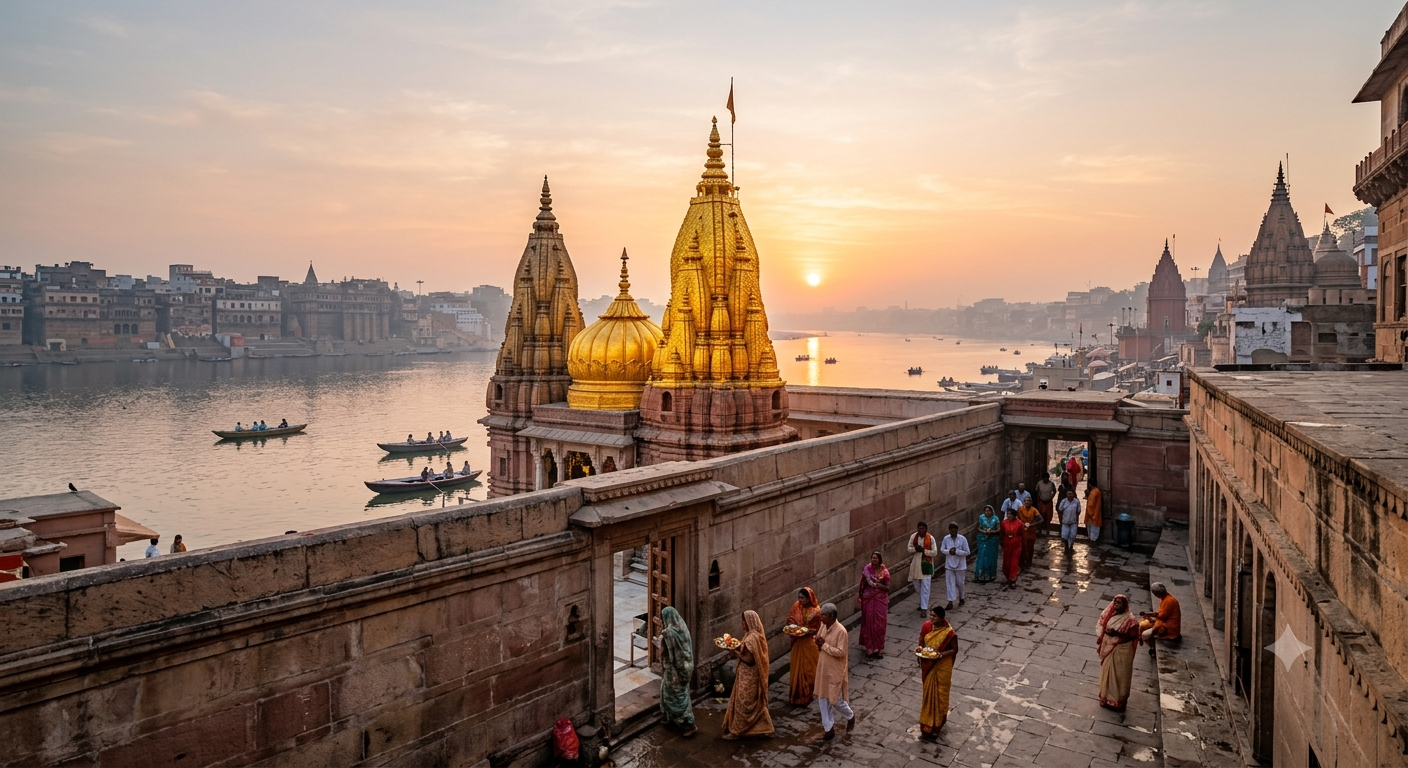
The Golden Temple of Varanasi
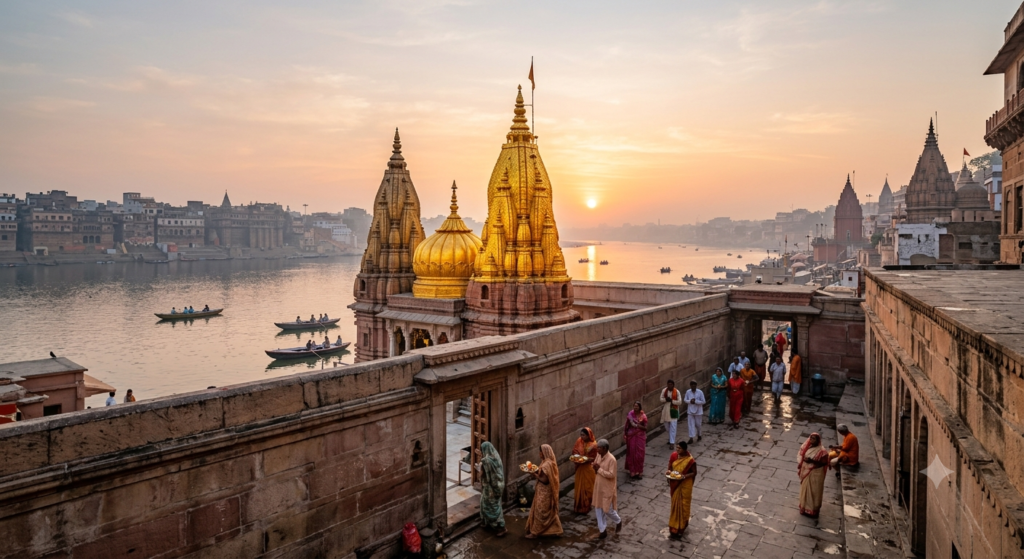
The temple’s iconic golden domes were donated by Maharaja Ranjit Singh, the ruler of the Sikh Empire, in the nineteenth century.
The gold-plated spires gleam brilliantly in the sunlight and have become one of the defining landmarks of Varanasi.
Visitors often pause to admire the shimmering temple architecture before entering for darshan.
Spiritual Significance of the Jyotirlinga
The term Jyotirlinga combines two Sanskrit words:
- Jyoti meaning “divine light.”
- Linga representing Lord Shiva.
According to Hindu tradition, Lord Shiva manifested as an endless column of light, symbolizing his infinite and eternal nature.
The Kashi Vishwanath Jyotirlinga represents:
- Divine consciousness
- Spiritual liberation
- Eternal knowledge
- Inner peace
- Universal energy
Devotees believe that sincere prayers offered here bring spiritual fulfillment and divine blessings.
The Path to Moksha
Kashi is uniquely associated with Moksha, the liberation from the cycle of birth and rebirth.
Many pilgrims perform sacred rituals, prayers, and ancestral ceremonies along the banks of the Ganga before visiting Kashi Vishwanath Temple.
This combination of temple worship and river rituals forms one of Hinduism’s most profound spiritual experiences.
Temple Architecture and Sacred Atmosphere
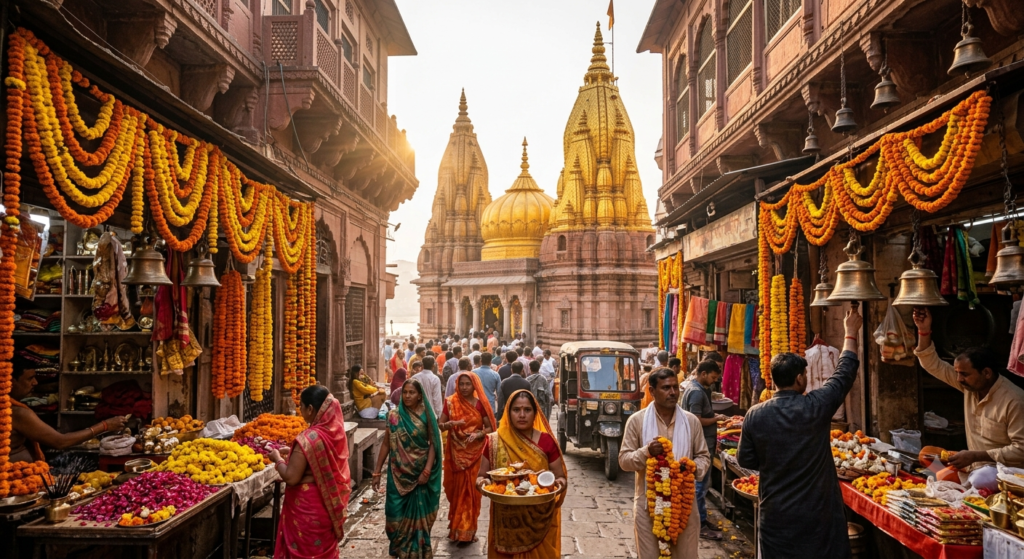
The architecture of Kashi Vishwanath Temple beautifully reflects the traditional Nagara style of North Indian temple design.
Although the temple complex is compact compared to many other pilgrimage sites, its spiritual energy and architectural elegance leave a lasting impression on visitors.
The narrow lanes leading to the temple are lined with flower vendors, incense shops, sweet stalls, and devotees chanting prayers, creating an atmosphere unlike anywhere else in India.
The Golden Spires
The temple’s gleaming golden shikharas dominate the skyline of old Varanasi and symbolize the divine presence of Lord Shiva.
These gold-plated towers have become one of the city’s most recognizable landmarks and are especially captivating during sunrise and sunset.
The Sanctum Sanctorum
At the heart of the temple lies the sacred Jyotirlinga, where devotees offer:
- Bilva leaves
- Milk
- Water from the River Ganga
- Flowers
- Sandalwood paste
The atmosphere inside the sanctum is filled with the sound of Vedic chants, temple bells, and heartfelt prayers.
The Eternal Spirit of Kashi
Every visit to Kashi Vishwanath Temple is more than a pilgrimage—it is an encounter with centuries of devotion, sacred traditions, and timeless spirituality.
From the sacred Jyotirlinga to the ancient streets of Varanasi, every step brings travelers closer to understanding why Kashi has inspired saints, seekers, and pilgrims for thousands of years.
Witness the Divine Ganga Aarti at Dashashwamedh Ghat
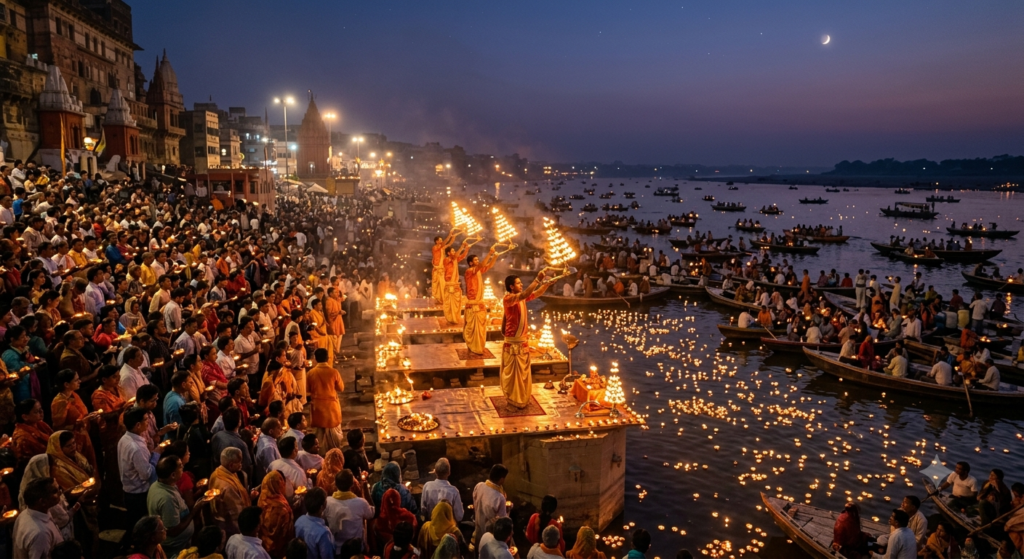
No pilgrimage to Kashi is complete without experiencing the world-famous Ganga Aarti at Dashashwamedh Ghat. Every evening, as the sun sets over the sacred River Ganga, the riverfront transforms into one of the most mesmerizing spiritual ceremonies in the world.
Priests dressed in traditional attire perform synchronized rituals using large brass lamps, incense, conch shells, and sacred chants while thousands of devotees gather to offer prayers to Mother Ganga.
The atmosphere becomes a beautiful blend of devotion, music, light, and fragrance that leaves visitors spiritually moved regardless of their faith.
Best Time to Attend
To secure a good viewing spot, it is advisable to arrive 45–60 minutes before the ceremony begins.
Visitors can choose between:
- Viewing from the ghat steps
- Watching from a traditional boat on the Ganga
- Reserved seating (available through authorized operators)
The boat experience offers a spectacular panoramic view of the illuminated ghats.
Photography Tips
The Ganga Aarti offers incredible photography opportunities.
Recommended equipment:
- Wide-angle lens
- Fast prime lens for low-light photography
- Tripod (where permitted)
- Extra batteries
Always remain respectful during the ceremony and avoid disturbing worshippers.
Exploring the Sacred Ghats of Varanasi
Varanasi is home to more than 80 ghats, each carrying centuries of religious, historical, and cultural significance.
These stone steps descending into the River Ganga form the spiritual heartbeat of the city.
Dashashwamedh Ghat
The most vibrant and visited ghat in Varanasi.
Known for:
- Evening Ganga Aarti
- Religious ceremonies
- Boat rides
- Festivals
- Sunrise photography
Assi Ghat
A peaceful destination favored by both pilgrims and travelers.
Popular for:
- Morning yoga sessions
- Classical music performances
- Sunrise boat rides
- Spiritual gatherings
Manikarnika Ghat
One of Hinduism’s most sacred cremation ghats.
According to tradition, cremation here grants liberation from the cycle of birth and death.
Visitors should maintain complete respect and avoid intrusive photography.
Harishchandra Ghat
Another important cremation ghat associated with the legendary King Harishchandra, symbolizing truth, sacrifice, and righteousness.
The Kashi Vishwanath Corridor
One of the most significant developments in recent years has been the creation of the Kashi Vishwanath Corridor, which has transformed access to the temple while preserving its ancient spiritual character.
The corridor provides a direct connection between the temple complex and the River Ganga, making movement easier for pilgrims and improving visitor facilities.
Enhanced Pilgrim Experience
The corridor includes:
- Wide walkways
- Landscaped public spaces
- Pilgrim amenities
- Information centers
- Improved security
- Rest areas
- Cultural exhibits
The project has significantly enhanced the overall pilgrimage experience while maintaining the sanctity of the temple.
Blending Heritage with Modern Infrastructure
The corridor successfully combines modern visitor facilities with the timeless heritage of Kashi, allowing millions of pilgrims to experience the temple more comfortably without compromising its spiritual atmosphere.
Sacred Places to Visit Near Kashi Vishwanath Temple
A visit to Varanasi offers numerous opportunities to explore nearby temples and spiritual landmarks.
Annapurna Devi Temple
Located close to Kashi Vishwanath Temple, this shrine is dedicated to Goddess Annapurna, the Hindu goddess of nourishment and abundance.
Many pilgrims visit this temple immediately after offering prayers to Lord Shiva.
Kal Bhairav Temple
Dedicated to Kal Bhairav, the guardian deity of Kashi, this temple is considered an essential stop during a traditional Varanasi pilgrimage.
According to local belief, no pilgrimage to Kashi is complete without seeking the blessings of Kal Bhairav.
Sankat Mochan Hanuman Temple
Founded by the saint Tulsidas, this famous temple is dedicated to Lord Hanuman and attracts devotees throughout the year.
Its peaceful surroundings provide a welcome contrast to the bustling streets of old Varanasi.
Sarnath
Located about 10 km from Varanasi, Sarnath is one of Buddhism’s most important pilgrimage sites.
This is where Lord Buddha delivered his first sermon after attaining enlightenment.
Visitors can explore:
- Dhamek Stupa
- Archaeological Museum
- Ashoka Pillar site
- Ancient monasteries
Sarnath adds a beautiful interfaith dimension to any Varanasi itinerary.
Best Time to Visit Kashi Vishwanath Temple
Although the temple welcomes pilgrims throughout the year, certain seasons provide more comfortable weather and vibrant festival experiences.
October to March
This is widely regarded as the best time to visit.
Advantages include:
- Pleasant weather
- Comfortable sightseeing
- Ideal for boat rides
- Numerous festivals
- Clear mornings for photography
Mahashivratri
Mahashivratri is one of the grandest celebrations at Kashi Vishwanath Temple.
Thousands of devotees gather to participate in:
- Special pujas
- Processions
- Night-long prayers
- Cultural celebrations
Accommodation should be booked well in advance during this period.
Dev Deepawali
Celebrated fifteen days after Diwali, Dev Deepawali transforms the ghats into a breathtaking spectacle with millions of oil lamps illuminating the riverfront.
It is considered one of the most beautiful times to visit Varanasi.
Best Overall Season
For comfortable weather, spiritual experiences, and sightseeing, October through March remains the ideal period for visiting Kashi Vishwanath Temple.
How to Reach Kashi Vishwanath Temple
Varanasi is well connected by air, rail, and road, making it easily accessible from major cities across India.
By Air
Nearest Airport:
Lal Bahadur Shastri International Airport (Varanasi Airport)
The airport offers regular flights connecting Varanasi with:
- Delhi
- Mumbai
- Bengaluru
- Hyderabad
- Kolkata
- Chennai
- Ahmedabad
The temple is approximately 25 km from the airport.
By Train
Nearest Railway Stations:
- Varanasi Junction
- Banaras Railway Station
- Pt. Deen Dayal Upadhyay Junction (Mughalsarai)
These stations connect Varanasi to nearly every major city in India.
By Road
Excellent highways connect Varanasi with:
- Prayagraj
- Lucknow
- Ayodhya
- Bodh Gaya
- Patna
Local transport includes:
- Auto-rickshaws
- E-rickshaws
- Taxis
- Cycle rickshaws
The final approach to the temple is typically completed on foot through the historic lanes.
Suggested 3-Day Spiritual Itinerary
Day 1
- Arrive in Varanasi
- Kashi Vishwanath Temple Darshan
- Annapurna Devi Temple
- Evening Ganga Aarti at Dashashwamedh Ghat
Day 2
- Sunrise boat ride on the Ganga
- Visit Assi Ghat
- Kal Bhairav Temple
- Sankat Mochan Hanuman Temple
- Explore Varanasi’s old lanes and local markets
Day 3
- Visit Sarnath
- Explore museums and archaeological sites
- Shopping for Banarasi silk
- Departure
Visitor Tips
To make your pilgrimage comfortable and meaningful:
- Dress modestly while visiting temples.
- Carry a valid government-issued ID.
- Follow temple security procedures.
- Avoid carrying unnecessary valuables.
- Wear comfortable footwear for walking.
- Stay hydrated, especially during warmer months.
- Respect photography restrictions inside temple premises.
- Arrive early for darshan to avoid long queues.
- Experience both sunrise and sunset along the ghats for a complete spiritual atmosphere.
Responsible Spiritual Tourism
A visit to Kashi Vishwanath Temple is much more than a sightseeing experience—it is a deeply sacred pilgrimage for millions of devotees. Respecting local customs, religious traditions, and the spiritual atmosphere helps preserve the sanctity of one of Hinduism’s holiest cities.
Responsible spiritual tourism ensures that Varanasi’s timeless heritage continues to inspire future generations.
Respect Temple Traditions
Every visitor should remember that Kashi Vishwanath is an active place of worship.
While visiting:
- Dress modestly.
- Follow temple security guidelines.
- Maintain silence inside the temple.
- Respect queues during darshan.
- Follow the instructions of temple authorities.
A respectful attitude enhances both your experience and that of fellow pilgrims.
Keep the Ghats Clean
The River Ganga is considered sacred by millions of devotees.
Help preserve its beauty by:
- Avoiding littering.
- Using designated waste bins.
- Avoiding plastic wherever possible.
- Not throwing food or packaging into the river.
- Supporting local cleanliness initiatives.
Every responsible traveler contributes to protecting this sacred river.
Support Local Communities
Varanasi’s traditional economy thrives on centuries-old craftsmanship and local businesses.
Support the community by:
- Purchasing authentic Banarasi silk directly from local weavers.
- Choosing locally operated boat rides.
- Dining at family-owned restaurants.
- Hiring licensed local guides.
- Respecting local customs and traditions.
Responsible tourism strengthens the city’s cultural heritage.
Photography Etiquette
Varanasi offers countless photographic opportunities, but sensitivity is essential.
Always:
- Ask permission before photographing people.
- Avoid photography inside restricted temple areas.
- Respect funeral ceremonies at cremation ghats.
- Maintain dignity when documenting religious rituals.
Thoughtful photography reflects respect for the city’s spiritual atmosphere.
Packing Checklist
Comfortable preparation helps make your pilgrimage more enjoyable.
Clothing
✔ Comfortable cotton clothing
✔ Modest attire suitable for temples
✔ Light shawl or stole
✔ Comfortable walking shoes
✔ Sandals for ghat visits
✔ Light sweater during winter mornings
Travel Essentials
✔ Government-issued ID
✔ Mobile charger
✔ Power bank
✔ Reusable water bottle
✔ Sunglasses
✔ Sunscreen
✔ Personal medications
✔ Small day backpack
Photography Gear
✔ DSLR or Mirrorless Camera
✔ Wide-angle lens
✔ Portrait lens
✔ Extra batteries
✔ Memory cards
✔ Lens cleaning kit
Spiritual Essentials
✔ Small offering plate (optional)
✔ Flowers (available locally)
✔ Prayer beads (if desired)
✔ Notebook for reflections
✔ Cash for donations and small purchases
Frequently Asked Questions (FAQs)
Is Kashi Vishwanath Temple open every day?
Yes.
The temple remains open throughout the year, although darshan timings and special rituals may vary during festivals and important religious occasions.
Visitors should check the latest timings before their visit.
Can non-Hindus visit Kashi Vishwanath Temple?
Current temple entry policies may vary. Non-Hindus are generally not permitted inside the sanctum, but they can explore many surrounding areas, the Kashi Vishwanath Corridor, and experience the spiritual atmosphere of Varanasi.
It is advisable to verify the latest entry guidelines before planning your visit.
What is the best time for darshan?
Early morning is considered the most peaceful time for darshan, with shorter queues and a serene atmosphere.
Many devotees also choose to attend the temple during special aartis and festivals.
How many days should I spend in Varanasi?
A 2–3 day itinerary is ideal.
This allows enough time to:
- Visit Kashi Vishwanath Temple
- Attend Ganga Aarti
- Explore the ghats
- Visit nearby temples
- Take a sunrise boat ride
- Visit Sarnath
What should I wear?
Visitors should wear modest clothing appropriate for a sacred place of worship.
Comfortable footwear is recommended, as much of the old city is explored on foot.
Is photography allowed inside the temple?
Photography is generally prohibited inside the temple complex.
Visitors are encouraged to enjoy the experience without cameras and to respect all posted regulations.
Photography is widely permitted around the ghats and many public areas of Varanasi.
Conclusion
The Kashi Vishwanath Temple Travel Guide is more than an introduction to one of India’s most revered temples—it is an invitation to experience the timeless spirituality of Varanasi, a city where faith, history, culture, and devotion have flourished for thousands of years.
From the sacred Jyotirlinga of Lord Shiva to the mesmerizing Ganga Aarti, the tranquil sunrise boat rides, the ancient ghats, and the vibrant lanes of Kashi, every moment offers an opportunity for reflection and spiritual connection.
Whether you come as a pilgrim seeking blessings, a traveler exploring India’s heritage, or a seeker searching for inner peace, Kashi leaves an unforgettable impression on every visitor.
The eternal city reminds us that spirituality is not merely found within temple walls—it lives in the chants echoing across the ghats, the flowing waters of the Ganga, the devotion of countless pilgrims, and the enduring faith that has shaped this sacred city for millennia.
If there is one spiritual destination every traveler should experience at least once in a lifetime, Kashi Vishwanath Temple undoubtedly belongs at the top of that list.
🌍 Explore More
“The greatest journeys are those that transform the heart. Walk ancient paths, embrace timeless traditions, and let every sacred destination inspire a deeper connection with yourself and the world.”
🌍 Explore More: BlueJay Explorations
📖 Read more travel stories: TravelAnecdotes.com
📸 Follow the journey on Instagram
👍 Follow us on Facebook
🎥 Watch cinematic travel stories on YouTube