Jim Corbett National Park Travel Guide: Discover India’s Oldest Tiger Reserve and Wildlife Paradise
Introduction
Nestled in the foothills of the Himalayas, Jim Corbett National Park is India’s oldest national park and one of the country’s most celebrated wildlife destinations. Established in 1936 as Hailey National Park, it laid the foundation for wildlife conservation in India and later became the birthplace of the historic Project Tiger initiative in 1973.
Spread across the picturesque landscapes of Uttarakhand, the park is renowned for its thriving population of majestic Royal Bengal Tigers, large herds of Asian elephants, hundreds of bird species, and breathtaking forests, rivers, and grasslands. Every safari through Corbett offers a unique opportunity to witness wildlife thriving in its natural habitat.
Named after the legendary conservationist and hunter-turned-naturalist Jim Corbett, the park continues to inspire nature lovers, wildlife photographers, researchers, and adventure seekers from around the globe. Beyond its remarkable biodiversity, the region also offers scenic landscapes, peaceful rivers, and rich cultural experiences that make every journey memorable.
Whether you’re planning your first tiger safari, an immersive wildlife photography expedition, or a relaxing nature retreat, this Jim Corbett National Park Travel Guide covers everything you need to know—from safari zones and wildlife highlights to travel tips, suggested itineraries, and the best time to visit.
Why Jim Corbett National Park is India’s Most Historic Wildlife Sanctuary
Jim Corbett National Park is far more than a wildlife destination—it represents the beginning of India’s conservation journey. As the country’s first national park and the birthplace of Project Tiger, it has played a crucial role in protecting endangered wildlife while inspiring generations of conservationists.
Today, it remains one of the best places in Asia to observe Bengal Tigers in their natural habitat while experiencing the incredible biodiversity of the Himalayan foothills.
India’s First National Park
Established in 1936, Jim Corbett National Park was originally named Hailey National Park after Sir Malcolm Hailey, then Governor of the United Provinces.
It was later renamed in honor of Jim Corbett, whose dedication to wildlife conservation transformed the way people viewed India’s forests and animals.
The park stands today as a symbol of India’s commitment to preserving its natural heritage.
Birthplace of Project Tiger
In 1973, Jim Corbett became the first tiger reserve under the Government of India’s ambitious Project Tiger program.
This landmark initiative was launched to protect the rapidly declining population of Bengal Tigers and restore their natural habitats.
Today, Project Tiger is regarded as one of the world’s most successful wildlife conservation programs, with Jim Corbett remaining one of its flagship reserves.
Why Every Wildlife Enthusiast Should Visit
Jim Corbett offers an exceptional combination of:
- Rich biodiversity
- Excellent tiger sightings
- Scenic landscapes
- Diverse safari experiences
- Birdwatching opportunities
- Wildlife photography
- Conservation history
It is a destination that appeals equally to families, photographers, researchers, and adventure travelers.
The History of Jim Corbett National Park
The story of Jim Corbett National Park is closely linked with the life of Edward James “Jim” Corbett, a British hunter who later became one of India’s earliest conservationists.
Known for tracking man-eating tigers and leopards that threatened local communities, Jim Corbett developed a profound respect for wildlife and became a passionate advocate for forest conservation.
His books, including Man-Eaters of Kumaon, introduced readers around the world to India’s forests and inspired global interest in wildlife conservation.
From Hailey National Park to Jim Corbett National Park
Originally designated as Hailey National Park, the reserve underwent several name changes before being officially renamed Jim Corbett National Park in recognition of Corbett’s remarkable contribution to wildlife protection.
Today, his legacy continues through conservation initiatives, eco-tourism, and environmental education programs.
A Model for Wildlife Conservation
The success of Jim Corbett National Park demonstrated that carefully managed protected areas could safeguard endangered species while supporting sustainable tourism.
Its conservation model has influenced wildlife management practices across India and beyond.
A Landscape Rich in Biodiversity
One of the greatest strengths of Jim Corbett National Park is its extraordinary diversity of habitats.
The park includes:
- Dense Sal forests
- Riverine belts
- Grasslands
- Marshes
- Hills
- Seasonal streams
- The Ramganga River and reservoir
These varied ecosystems support an incredible range of wildlife throughout the year.
The Royal Bengal Tiger
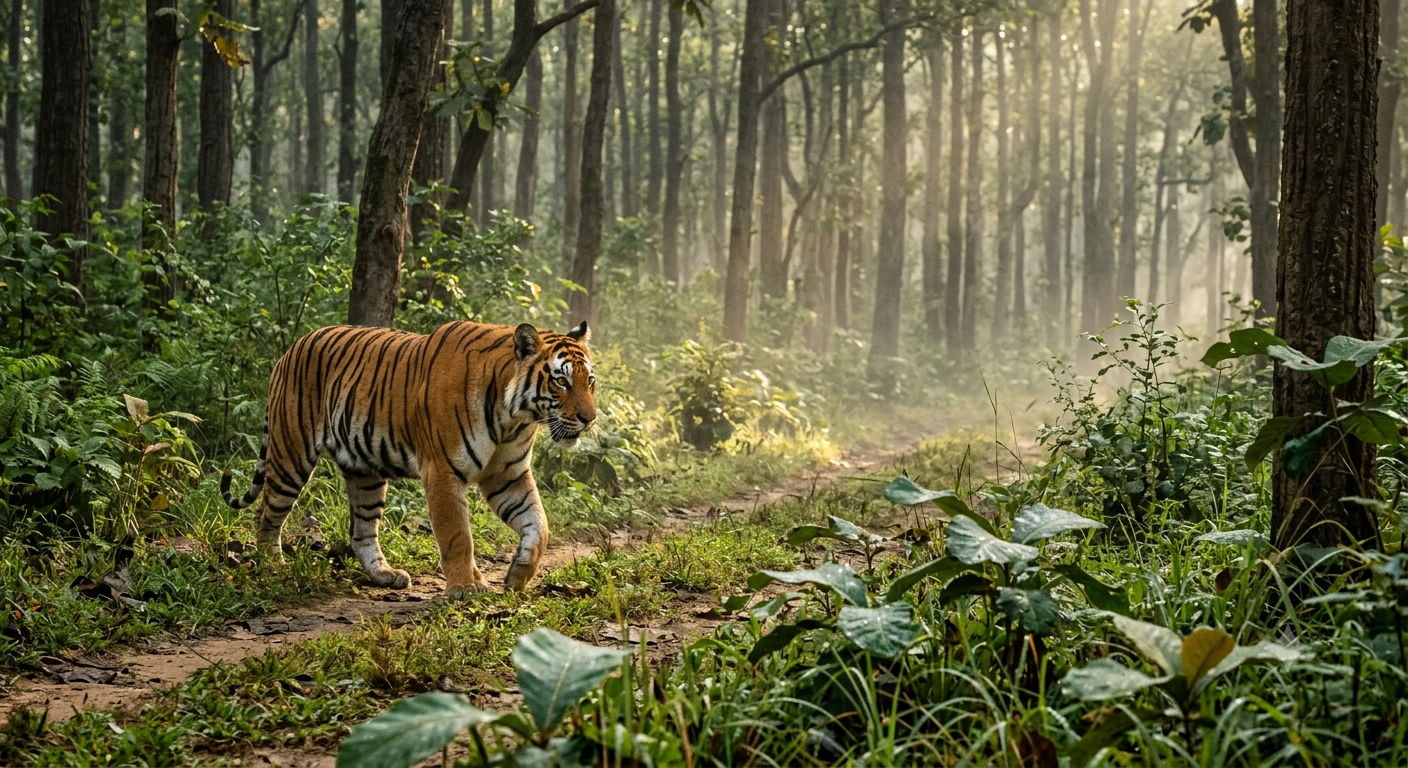
The undisputed icon of Jim Corbett National Park is the magnificent Royal Bengal Tiger.
The park supports one of India’s healthiest tiger populations, making it one of the country’s premier destinations for tiger safaris.
Although sightings are never guaranteed, every safari offers the thrilling possibility of encountering this elusive predator in its natural habitat.
Asian Elephants
Large herds of wild Asian elephants roam freely through Corbett’s forests and grasslands.
Watching these gentle giants move gracefully across riverbeds and forest clearings is one of the park’s most memorable experiences.
Rich Birdlife
Jim Corbett is also recognized as one of India’s finest birdwatching destinations.
More than 600 species of birds have been recorded here, including:
- Great Hornbill
- Crested Serpent Eagle
- Pallas’s Fish Eagle
- Kingfishers
- Woodpeckers
- Barbets
- Minivets
- Flycatchers
- Owls
Birdwatchers visit throughout the year, with winter bringing numerous migratory species.
Flora of Jim Corbett National Park
The park’s forests are dominated by towering Sal trees, interspersed with bamboo groves, grasslands, riverine vegetation, and mixed deciduous forests.
These diverse plant communities provide food and shelter for countless animal species while creating breathtaking scenery throughout the seasons.
The changing landscapes—from misty forests to sunlit grasslands and winding rivers—make every safari visually spectacular.
The Ramganga River
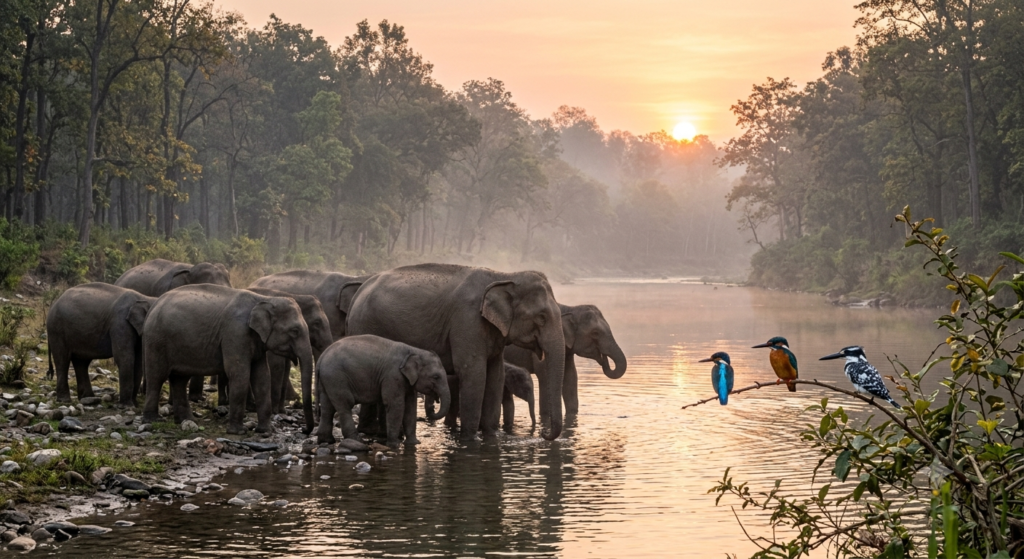
Flowing through the heart of the park, the Ramganga River sustains much of Corbett’s wildlife.
Its calm waters attract:
- Tigers
- Elephants
- Deer
- Crocodiles
- Otters
- Numerous bird species
Many of the park’s most iconic wildlife photographs are taken along the riverbanks during the early morning hours.
Where Conservation Meets Adventure
Jim Corbett National Park is much more than a place to search for tigers. It is a living classroom where visitors can witness the delicate balance of nature, understand the importance of conservation, and experience one of India’s richest wildlife ecosystems.
Every safari through its forests tells a different story, making each visit unique and unforgettable.
Safari Zones of Jim Corbett National Park
One of the unique features of Jim Corbett National Park is its well-managed safari system. The park is divided into multiple tourism zones, each offering distinct landscapes, wildlife habitats, and safari experiences.
Every zone provides a different perspective of Corbett’s extraordinary biodiversity, encouraging visitors to return and explore new areas on subsequent trips.
Dhikala Zone
The Dhikala Zone is the most famous and sought-after safari area in Jim Corbett National Park.
Known for:
- Excellent tiger sightings
- Expansive grasslands
- Large elephant herds
- Rich birdlife
- Overnight forest rest houses
- Stunning Ramganga Reservoir views
For many wildlife enthusiasts, Dhikala offers the ultimate Corbett safari experience.
Bijrani Zone
The Bijrani Zone is one of the most popular safari areas due to its proximity to Ramnagar and consistently rewarding wildlife sightings.
Highlights include:
- Dense Sal forests
- Open grasslands
- Tigers
- Leopards
- Wild elephants
- Deer species
- Rich birdlife
Its varied habitats make every safari exciting.
Jhirna Zone
Unlike some safari zones that remain closed during the monsoon, Jhirna generally remains open throughout the year.
Wildlife commonly seen includes:
- Sloth bears
- Wild boars
- Tigers
- Leopards
- Deer
- Numerous bird species
This makes Jhirna an excellent option for visitors traveling during the rainy season.
Dhela Zone
The Dhela Zone combines beautiful forests with open landscapes.
Visitors frequently encounter:
- Elephants
- Jackals
- Deer
- Birds
- Tigers (occasionally)
It offers a quieter safari experience with fewer crowds.
Durga Devi Zone
Located in the northeastern section of the park, this zone is especially popular among birdwatchers.
Highlights include:
- Mountain streams
- Dense forests
- Himalayan foothill scenery
- Otters
- Mahseer fish
- Rare birds
- Leopards
The scenic beauty of Durga Devi makes it one of the park’s hidden gems.
Garjia & Sitabani (Buffer Areas)
Although Sitabani lies outside the official core national park, it offers excellent wildlife viewing opportunities.
Visitors may spot:
- Elephants
- Leopards
- Deer
- Birds
- Reptiles
These areas also carry historical and mythological significance.
Jeep Safari Experience
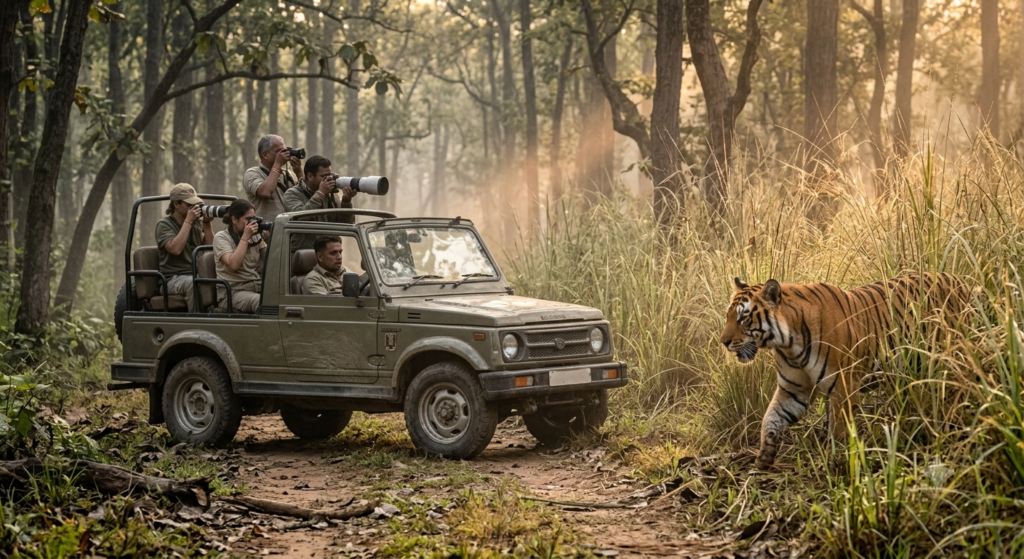
The Jeep Safari is undoubtedly the most popular way to explore Jim Corbett National Park.
Open 4×4 vehicles allow visitors to travel deep into the forest while offering outstanding visibility for wildlife observation and photography.
Professional naturalist guides accompany every safari, sharing fascinating insights about the park’s ecosystem.
Morning Safari
Morning safaris begin shortly after sunrise.
Advantages:
- Pleasant temperatures
- Active wildlife
- Excellent photography light
- Higher chances of predator sightings
Early mornings often provide the best opportunities to observe tigers and elephants.
Evening Safari
Evening safaris showcase a completely different atmosphere.
Visitors enjoy:
- Golden-hour landscapes
- Animals returning to water sources
- Beautiful sunsets
- Rich bird activity
The warm evening light creates spectacular photographic conditions.
Meet the Royal Bengal Tigers of Corbett
Jim Corbett National Park is internationally recognized for its healthy population of Royal Bengal Tigers.
Although tiger sightings can never be guaranteed, Corbett consistently ranks among India’s best destinations for observing these magnificent predators in the wild.
Every safari carries the thrilling possibility of encountering one of nature’s most iconic animals.
Tiger Territory
Tigers prefer:
- Dense forests
- Riverbanks
- Grasslands
- Waterholes
Experienced guides carefully interpret fresh pugmarks, alarm calls, and other wildlife behavior to increase the chances of locating a tiger.
Wildlife Photography Opportunities
Corbett offers exceptional opportunities for wildlife photographers.
Popular subjects include:
- Tigers
- Elephants
- Leopards
- Crocodiles
- Deer
- Birds
- Scenic landscapes
Golden-hour lighting combined with dramatic forest settings produces stunning photographs.
Elephants and Other Wildlife
Although tigers attract the most attention, Jim Corbett’s incredible biodiversity extends far beyond its apex predator.
Asian Elephants
Large elephant herds frequently roam the forests and riverbanks.
Watching family groups interact naturally is one of the most memorable experiences in Corbett.
Leopards
Although highly elusive, leopards inhabit many areas of the park.
Patient visitors occasionally enjoy rare sightings during safaris.
Deer Species
Several herbivores support the park’s healthy predator population.
Common sightings include:
- Chital (Spotted Deer)
- Sambar Deer
- Barking Deer
- Hog Deer
These graceful animals are seen throughout the park.
Other Mammals
Additional wildlife includes:
- Sloth Bear
- Himalayan Black Bear (higher elevations)
- Golden Jackal
- Jungle Cat
- Fishing Cat
- Otter
- Wild Boar
- Langur
- Rhesus Macaque
Every safari offers a different combination of wildlife encounters.
A Paradise for Birdwatchers
Jim Corbett National Park is widely regarded as one of India’s finest birding destinations.
With more than 600 recorded bird species, it attracts birdwatchers from around the world.
Resident Birds
Commonly observed species include:
- Great Hornbill
- Crested Serpent Eagle
- Changeable Hawk Eagle
- White-throated Kingfisher
- Indian Pitta
- Green Bee-eater
- Barbet
- Woodpecker
Migratory Birds
Winter months bring migratory visitors from Central Asia and Europe.
This period offers the greatest diversity for bird photography and birdwatching.
Best Time to Visit Jim Corbett National Park
Each season offers unique wildlife experiences.
November to February
Winter is one of the most comfortable seasons.
Advantages:
- Pleasant weather
- Excellent birdwatching
- Beautiful landscapes
- Comfortable safaris
March to June
Summer offers the highest probability of tiger sightings.
As temperatures rise, wildlife frequently visits water sources.
Photographers often prefer this season despite the warmer weather.
Monsoon Season
During the monsoon, some safari zones close for ecological restoration, while others remain open.
The forests become lush and vibrant, offering spectacular scenery.
Best Overall Time
For wildlife photography and tiger sightings, March to June is ideal.
For pleasant weather and birdwatching, November to February remains the preferred season.
How to Reach Jim Corbett National Park
The primary gateway to the park is Ramnagar.
By Air
Nearest Airport:
Pantnagar Airport
Approximately 80 km from Ramnagar.
Regular road transfers connect the airport to the park.
The nearest major international gateway is Indira Gandhi International Airport, New Delhi.
By Train
Nearest Railway Station:
Ramnagar Railway Station
Direct train connections are available from:
- Delhi
- Moradabad
- Haridwar
By Road
Jim Corbett National Park is well connected by road.
Approximate driving distances:
- Delhi – 250 km
- Nainital – 65 km
- Dehradun – 230 km
Private taxis, buses, and self-drive vehicles are commonly used.
Suggested 3-Day Wildlife Itinerary
Day 1
- Arrive at Ramnagar
- Resort check-in
- Evening Jeep Safari
- Wildlife interpretation session
Day 2
- Early morning safari
- Breakfast
- Visit Corbett Museum
- Relax by the Kosi River
- Evening safari
Day 3
- Birdwatching walk
- Nature photography
- Local handicraft shopping
- Departure
Visitor Tips
To make the most of your wildlife adventure:
- Book safari permits well in advance.
- Carry a valid government-issued ID.
- Wear earth-toned clothing (green, brown, beige).
- Avoid bright colors and strong perfumes.
- Remain silent during safaris.
- Never feed or disturb wildlife.
- Follow your naturalist’s instructions.
- Carry binoculars and a telephoto lens.
- Keep sufficient water during summer safaris.
- Respect park rules and maintain a safe distance from animals.
Responsible Wildlife Tourism
Jim Corbett National Park is one of India’s most important protected ecosystems and a global symbol of wildlife conservation. Every visitor plays a vital role in preserving its forests, rivers, and incredible biodiversity for future generations.
Responsible wildlife tourism not only protects endangered species but also supports local communities and sustainable conservation initiatives.
Respect Wildlife
Wild animals should always be observed from a safe distance.
During safaris:
- Never attempt to feed animals.
- Avoid loud conversations or music.
- Do not imitate animal calls.
- Never leave the vehicle unless instructed by forest officials.
- Respect animal movement and natural behavior.
Remember, you are a guest in their home.
Keep the Forest Clean
Help preserve the beauty of Jim Corbett National Park by:
- Carrying reusable water bottles.
- Avoiding single-use plastics.
- Taking back all waste.
- Using designated waste bins outside the park.
- Never throwing food into the forest.
Simple actions help protect fragile ecosystems.
Support Local Communities
The villages surrounding Jim Corbett benefit greatly from eco-tourism.
Support local livelihoods by:
- Hiring certified local guides.
- Staying in eco-friendly accommodations.
- Purchasing locally made handicrafts.
- Dining at locally owned restaurants.
- Respecting village customs and traditions.
Responsible tourism creates positive economic opportunities while encouraging conservation.
Wildlife Photography Ethics
Jim Corbett is one of India’s premier wildlife photography destinations.
While photographing wildlife:
- Never use flash around animals.
- Maintain silence.
- Avoid blocking animal movement.
- Do not pressure guides to approach wildlife too closely.
- Prioritize animal welfare over photographs.
Ethical photography tells better stories while protecting wildlife.
Packing Checklist
Packing appropriately ensures a safe, comfortable, and enjoyable safari experience.
Clothing
✔ Neutral-colored shirts (green, brown, beige)
✔ Comfortable trekking trousers
✔ Light fleece jacket (winter mornings)
✔ Hat or cap
✔ Comfortable walking shoes
✔ Sunglasses
✔ Lightweight rain jacket (monsoon)
Travel Essentials
✔ Government-issued ID
✔ Safari booking confirmation
✔ Mobile charger
✔ Power bank
✔ Sunscreen
✔ Insect repellent
✔ Reusable water bottle
✔ Small backpack
Photography Gear
✔ DSLR or Mirrorless Camera
✔ 300–600 mm telephoto lens
✔ Wide-angle lens
✔ Extra batteries
✔ Memory cards
✔ Lens cleaning kit
✔ Bean bag for vehicle support
✔ Binoculars
Health & Safety
✔ Personal medicines
✔ First-aid kit
✔ Hand sanitizer
✔ Energy snacks
✔ Lip balm
✔ Moisturizer
Frequently Asked Questions (FAQs)
What is Jim Corbett National Park famous for?
Jim Corbett National Park is famous for being:
- India’s oldest national park
- The first reserve under Project Tiger
- Home to the Royal Bengal Tiger
- Rich birdlife
- Diverse forest ecosystems
- Outstanding wildlife safaris
Which safari zone is best?
The most popular safari zones include:
- Dhikala
- Bijrani
- Jhirna
Each zone offers unique landscapes and wildlife experiences, and no single zone guarantees tiger sightings.
How many safaris should I book?
For the best wildlife experience, plan at least three to four safaris across different zones.
Multiple safaris significantly increase the chances of observing diverse wildlife.
What is the best time to see tigers?
Tiger sightings are generally more frequent during March to June, when animals visit water sources more often.
However, wildlife sightings always depend on natural conditions and cannot be guaranteed.
Is Jim Corbett suitable for children?
Yes.
Families with children enjoy:
- Jeep safaris
- Birdwatching
- Nature interpretation
- Resort activities
- Educational wildlife experiences
Many resorts also organize guided nature walks and conservation programs.
Can I book safaris online?
Yes.
Safari permits can be booked through the official Uttarakhand Forest Department portal or authorized tourism operators.
Advance reservations are strongly recommended, particularly during weekends, holidays, and peak travel seasons.
Conclusion
The Jim Corbett National Park Travel Guide is more than a handbook for planning a safari—it is an invitation to experience one of India’s greatest conservation success stories. From the thrill of tracking the majestic Royal Bengal Tiger to the peaceful beauty of the Ramganga River, every journey through Corbett reveals the extraordinary diversity of the Himalayan foothills.
Whether you’re watching a herd of elephants crossing a forest trail, photographing colorful birds at sunrise, or simply enjoying the serenity of ancient Sal forests, the park offers unforgettable moments for every nature lover.
As India’s first national park and the birthplace of Project Tiger, Jim Corbett continues to inspire wildlife conservation while providing visitors with one of the finest safari experiences in Asia.
Whether you’re a wildlife photographer, birdwatcher, family traveler, or adventure enthusiast, Jim Corbett National Park promises memories that will last a lifetime.
🌍 Explore More
“Nature reveals its greatest wonders to those who travel with patience, respect, and curiosity. Every forest tells a story, every river nurtures life, and every safari is an opportunity to reconnect with the wild.”
🌍 Explore More: BlueJay Explorations
📖 Read more travel stories: TravelAnecdotes.com
📸 Follow the journey on Instagram
👍 Follow us on Facebook
🎥 Watch cinematic travel stories on YouTube