Cherrapunji Travel Guide: Waterfalls, Clouds & the Wettest Landscapes
There are places you visit for the monuments, places you visit for the beaches, and places you visit for the mountains.
Then there is Cherrapunji.
Here, the landscape itself is the attraction.
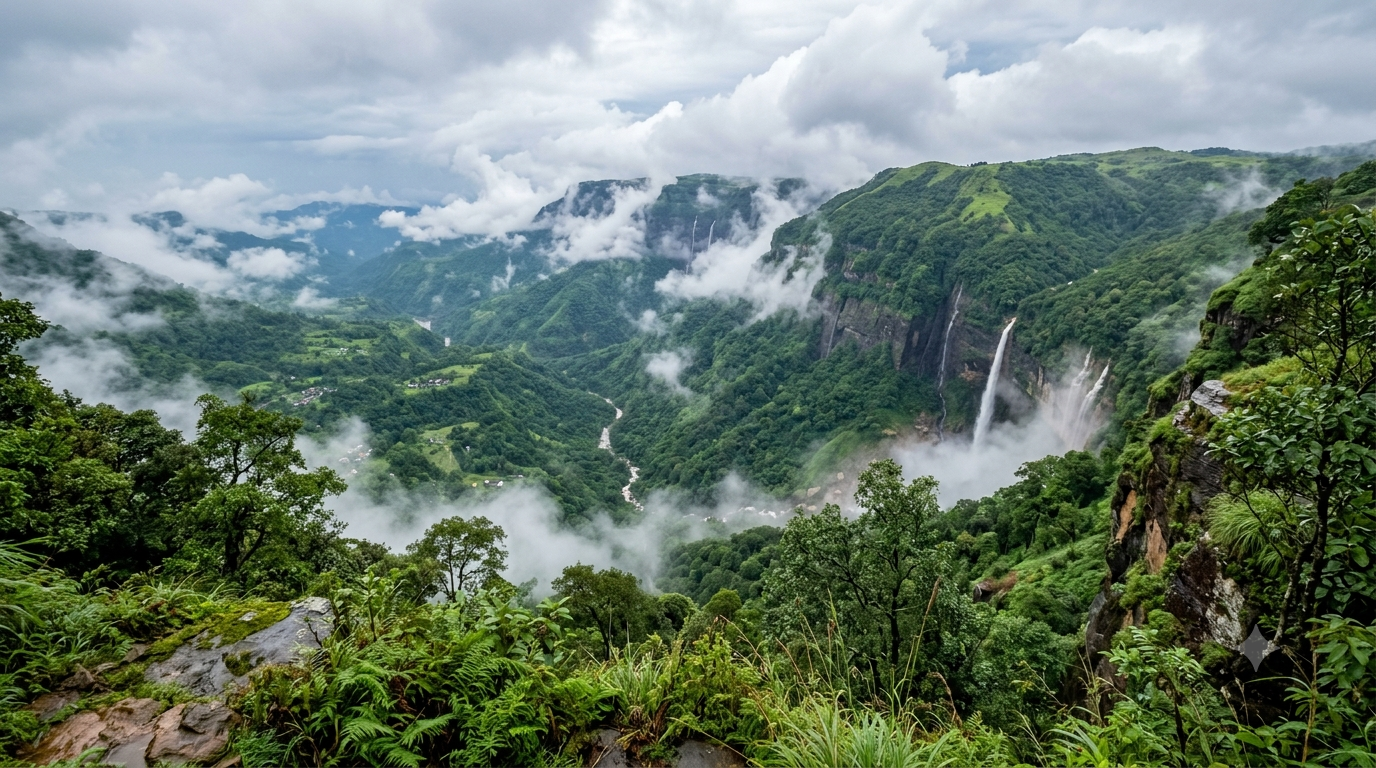
Rain rolls across the Khasi Hills. Clouds drift over deep green valleys. Waterfalls appear dramatically along cliffs. Forest trails disappear into mist, and caves lead you into another side of Meghalaya’s remarkable natural world.
Known locally as Sohra, Cherrapunji has become one of India’s most memorable destinations for travellers seeking waterfalls, clouds, forests, caves and slower experiences in nature.
A good Cherrapunji travel guide therefore shouldn’t be only about a list of sightseeing spots. The real experience is understanding how rain has shaped this landscape and learning to enjoy a destination where weather is part of the journey.
If you’re planning a trip to Meghalaya, Cherrapunji deserves more than a quick stop.
It deserves time.
Quick Facts About Cherrapunji
- Destination: Cherrapunji (Sohra), Meghalaya
- Region: Khasi Hills, Northeast India
- Known for: Waterfalls, caves, clouds, rain and living root bridges
- Major attractions: Nohkalikai Falls, Seven Sisters Falls, Mawsmai Cave, Arwah Cave and living root bridges
- Nearest major city: Shillong
- Ideal duration: 2–3 days for a first visit
- Travel character: Nature, waterfalls, trekking, caves, landscapes and local culture
Cherrapunji is approximately 50 km from Shillong, with the journey itself taking you through winding roads, green hills and mist-covered landscapes.
Why Cherrapunji Feels Different From Other Hill Destinations
Many hill destinations are defined by their altitude.
Cherrapunji is defined by its relationship with rain.
The weather doesn’t simply influence the landscape here. It has helped create it.
A Landscape Shaped by Rain
Rainwater runs through the Khasi Hills, feeding streams and waterfalls and carving its way through limestone landscapes.
During wetter periods, cliffs that may look relatively quiet at another time of year can suddenly become spectacular curtains of falling water.
This is one of the reasons Cherrapunji feels constantly alive.
You don’t simply arrive at a viewpoint and look at a landscape.
You watch the landscape change around you.
Where Clouds Become Part of the Journey
One moment, you may have a clear view across the valleys.
A few minutes later, mist can roll across the hills and completely transform the scene.
Roads disappear into clouds. Trees become silhouettes. Valleys seem to fade into the distance.
For travellers who enjoy atmospheric landscapes and photography, this changing weather is part of Cherrapunji’s magic.
Waterfalls Around Every Turn
Few things define the Cherrapunji experience more than waterfalls.
Some are enormous and dramatic.
Others are smaller cascades hidden among forests and cliffs.
During the rainy season, the Khasi Hills can feel as though water is flowing from every direction.
Nohkalikai Falls: Cherrapunji’s Dramatic Waterfall
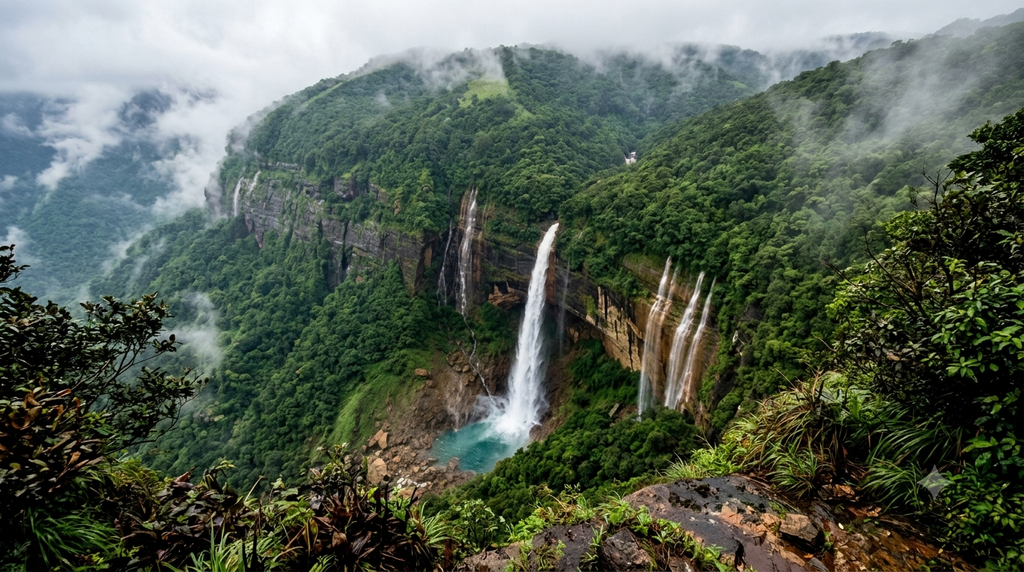
If there is one waterfall that belongs on almost every first-time Cherrapunji travel guide, it is Nohkalikai Falls.
Located near Sohra, Nohkalikai is one of the most dramatic waterfalls in Meghalaya, plunging approximately 340 metres from the plateau into a striking blue-green pool below.
The scale is difficult to understand until you see it.
The Dramatic Plunge
From the viewpoint, the waterfall appears to fall almost vertically into the valley.
The surrounding cliffs and dense greenery make the scene even more dramatic.
On cloudy days, the waterfall can feel completely different from the experience on a bright afternoon.
Mist softens the distant landscape, while sunlight can bring out the colours of the water and surrounding vegetation.
The Turquoise Pool Below
One of the most distinctive features of Nohkalikai Falls is the blue-green pool at the bottom.
From above, the colour contrasts beautifully with the darker cliffs and surrounding vegetation.
It is one of those landscapes where photographs capture only part of the experience.
The scale, sound and depth of the valley are something you have to experience in person.
Experiencing Nohkalikai in Different Weather
Weather can dramatically change the appearance of the falls.
After heavy rain, the waterfall can appear especially powerful.
During clearer conditions, the valley becomes easier to see.
If you’re travelling through Meghalaya, don’t worry if your first view isn’t perfect.
The landscape can change quickly.
Seven Sisters Falls: When the Water Comes Alive
Another iconic waterfall experience near Cherrapunji is Seven Sisters Falls, also known as Nohsngithiang Falls.
The waterfall descends dramatically over the limestone cliffs of the Khasi Hills.
When the Waterfalls Come Alive
Seven Sisters Falls is particularly associated with the monsoon landscape.
Rain increases the flow, turning the cliffs into dramatic ribbons of white water against the green landscape.
The surrounding valleys add to the sense of scale.
Landscape Around the Viewpoint
The waterfall is only part of the experience.
Look beyond the falling water and you’ll see layers of hills, valleys, vegetation and clouds.
This is one of those places where it’s worth putting the camera down for a few moments.
Simply watch the landscape.
Why Monsoon Changes the Experience
The monsoon doesn’t merely make the waterfall wetter.
It transforms the entire environment.
The vegetation becomes intensely green, streams become fuller and clouds move through the valleys.
The same viewpoint can therefore feel completely different depending on the weather.
Mawsmai Cave: Into the Limestone Landscape
Cherrapunji isn’t only about waterfalls.
Beneath its dramatic landscape lies another world of limestone caves.
Mawsmai Cave is one of the most accessible cave experiences around Sohra.
The cave extends roughly 150 metres and includes narrow passages, chambers and interesting limestone formations.
Limestone Formations
Inside the cave, water and limestone have worked together over long periods to create unusual natural shapes.
The darkness, rock surfaces and narrow passages create an experience completely different from the open landscapes outside.
Narrow Passages and Chambers
Mawsmai is relatively manageable for visitors who want to experience a cave without committing to a highly technical expedition.
Some sections are narrow, however, so comfortable clothing and footwear are important.
The transition is fascinating.
One moment you’re standing among misty Khasi Hills.
The next, you’re moving through a cool limestone passage beneath the ground.
Arwah Cave: A Quieter Cave Experience
For travellers looking for something a little more adventurous, Arwah Cave offers another fascinating side of the Sohra landscape.
Unlike the more accessible Mawsmai experience, reaching Arwah Cave involves walking through forested surroundings.
The journey itself becomes part of the attraction.
The cave contains limestone formations and fossil-related features, while the surrounding forest adds to the feeling of discovering something away from the busiest tourist routes.
If you enjoy combining walking, nature and exploration, Arwah Cave can make a memorable addition to your Cherrapunji trip.
Living Root Bridges Around Cherrapunji
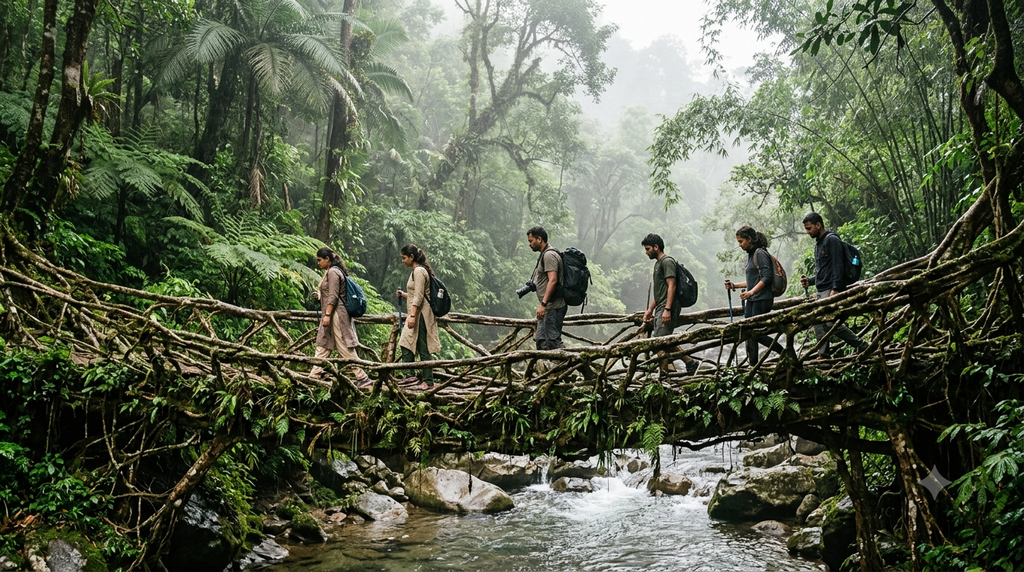
Some of Meghalaya’s most extraordinary structures aren’t made from concrete, steel or stone.
They are alive.
The living root bridges of Meghalaya are created by guiding the roots of rubber fig trees over streams and across natural gaps.
Over generations, these roots grow, strengthen and form functional bridges.
When Nature Becomes Architecture
A living root bridge is more than a remarkable photograph.
It represents a relationship between people and the forest.
Instead of replacing nature with an artificial structure, local communities have learned to work with living trees and roots.
The result is an extraordinary form of natural architecture.
For a deeper look at this experience, explore our Living Root Bridge Trek in Meghalaya.
The Khasi Relationship With Forests
The root bridges are a powerful reminder that landscapes aren’t simply scenery.
They can also be part of local knowledge, tradition and everyday life.
This is one reason travelling through Meghalaya feels different from simply visiting a conventional tourist attraction.
You’re experiencing a living cultural landscape.
Journey Toward Nongriat
The journey towards Nongriat and its famous root bridges involves substantial walking and stairs.
It isn’t simply a viewpoint experience.
You need time, comfortable footwear and a willingness to walk.
But for travellers who enjoy active experiences, the journey can become one of the highlights of a Meghalaya trip.
Clouds, Mist and Rain: The Soul of Cherrapunji
Perhaps the easiest mistake to make when visiting Cherrapunji is treating rain as an inconvenience.
Here, rain is part of the experience.
A sudden shower can change the colour of the forest.
Mist can hide an entire valley.
Clouds can move across the hills like curtains.
Water can appear along cliffs that looked dry earlier.
This is why Cherrapunji is particularly rewarding for slow travellers.
You don’t always know exactly what the landscape will look like when you arrive.
And that’s part of the fun.
Things to Do in Cherrapunji
A memorable Cherrapunji trip doesn’t need an exhausting checklist.
Instead, combine a few major attractions with time to experience the landscape.
Chase Waterfalls
Visit Nohkalikai Falls, Seven Sisters Falls and other waterfalls around Sohra.
Allow time to simply enjoy the viewpoints rather than rushing between them.
Explore Limestone Caves
Mawsmai Cave is an accessible introduction to the underground landscapes of Meghalaya.
For a more exploratory experience, consider Arwah Cave.
Walk Through Misty Forests
Some of the best moments in Cherrapunji happen between major attractions.
Walk through forest paths, stop at viewpoints and allow yourself to experience the changing weather.
Trek Toward Living Root Bridges
If you’re comfortable with a more active day, include a living root bridge trek.
The journey offers forests, village landscapes, streams and one of Meghalaya’s most remarkable examples of traditional ecological knowledge.
Photograph Clouds and Valleys
Cherrapunji rewards patient photographers.
Instead of waiting only for clear skies, photograph the mist, changing clouds, wet roads, waterfalls and atmospheric landscapes.
Experience Khasi Landscapes and Local Life
Travel slowly through the region and pay attention to villages, roads, forests and local landscapes.
The experience becomes richer when you look beyond the major attractions.
Best Time to Visit Cherrapunji
There isn’t one universally perfect time to visit Cherrapunji.
The best season depends on the kind of experience you want.
Cherrapunji During the Monsoon
If your priority is dramatic waterfalls, intense greenery, rain and clouds, the monsoon offers an extraordinary landscape.
However, heavy rain can also affect visibility, roads and outdoor plans.
Come prepared for changing conditions.
Post-Monsoon Cherrapunji
The months after the heaviest rains can offer a different balance of greenery, waterfalls and more manageable weather.
This can be a good period for travellers who want to explore more comfortably while still enjoying Meghalaya’s landscapes.
Winter in Cherrapunji
Cooler and generally drier conditions can make sightseeing and cave exploration more comfortable.
The waterfalls may not have the same monsoon intensity, but clearer views can create their own appeal.
How to Reach Cherrapunji
From Shillong
Shillong is the most common starting point for travellers visiting Cherrapunji.
The road journey takes you through scenic Khasi Hills landscapes and winding mountain roads.
You can travel by private vehicle, taxi or other locally available transport options.
From Guwahati
Travellers arriving by air or rail often use Guwahati as their gateway to Meghalaya.
From Guwahati, the journey continues towards Shillong and then onward to Sohra.
The route is scenic but should be planned with sufficient travel time.
By Air
The nearest major airport commonly used for Meghalaya travel is Guwahati’s Lokpriya Gopinath Bordoloi International Airport.
From there, road travel is required to reach Cherrapunji.
By Road
For many travellers, road travel is part of the experience.
The journey through Meghalaya introduces you to green hills, winding roads, clouds and changing landscapes even before you reach Sohra.
How Many Days Are Enough for Cherrapunji?
2 Days in Cherrapunji
A two-day trip can cover major attractions such as:
- Nohkalikai Falls
- Seven Sisters Falls
- Mawsmai Cave
- Selected viewpoints
- Nearby waterfalls
It works well for travellers with limited time.
3 Days in Cherrapunji
Three days gives you more breathing room.
You can include:
- Major waterfalls
- Mawsmai Cave
- Arwah Cave
- Living root bridge experience
- Forest walks
- Additional viewpoints
- Local exploration
For a first-time visit, three days allows the destination to feel less rushed.
Longer Stays
If you’re building a larger Meghalaya itinerary, Cherrapunji can become one part of a broader journey covering Shillong, Mawlynnong, Dawki and other destinations.
A Sample 3-Day Cherrapunji Itinerary
Day 1 — Waterfalls and Landscapes
Begin with the major waterfall experiences.
Visit:
- Nohkalikai Falls
- Seven Sisters Falls
- Scenic viewpoints
- Other nearby waterfall stops
End the day slowly as clouds and mist move across the hills.
Day 2 — Caves and Forests
Explore:
- Mawsmai Cave
- Arwah Cave
- Forest surroundings
- Local viewpoints
Keep the day flexible because weather can influence outdoor plans.
Day 3 — Living Root Bridges and Slow Travel
Set aside the day for a living root bridge experience.
Start early, walk through forest landscapes and take time to appreciate the journey rather than treating the bridge as simply another attraction to photograph.
Return to Sohra and spend the evening enjoying the landscape at a slower pace.
What to Pack for Cherrapunji
The weather can change quickly, so practical preparation matters.
Consider carrying:
- Waterproof jacket or raincoat
- Quick-drying clothes
- Comfortable walking shoes
- Extra socks
- Waterproof bag or backpack cover
- Phone/camera protection
- Small first-aid kit
- Reusable water bottle
- Personal medicines
- Light warm clothing
- Power bank
For trekking days, pack as lightly as possible.
Wet weather and long walks are much easier when you’re not carrying unnecessary weight.
Responsible Travel in Cherrapunji
Cherrapunji’s beauty is also fragile.
Travellers can help protect the landscape by following simple practices.
Avoid Single-Use Plastic
Carry reusable bottles and bags whenever possible.
Don’t Leave Waste Behind
Take your waste with you when bins aren’t available.
Respect Local Communities
Villages and traditional landscapes aren’t simply tourist attractions.
Respect local customs, privacy and community spaces.
Stay on Appropriate Trails
Avoid damaging vegetation or taking shortcuts through sensitive areas.
Don’t Disturb Wildlife
Observe birds and animals from a distance.
Support Local Guides and Businesses
Where appropriate, use local guides, transport providers, homestays and businesses.
Responsible travel helps ensure that destinations remain meaningful for both communities and future travellers.
Photography in Cherrapunji
Cherrapunji can challenge photographers in interesting ways.
The weather changes constantly, so don’t expect every landscape to have perfect light.
Instead, embrace atmospheric photography.
Photograph:
- Waterfalls disappearing into mist
- Clouds crossing valleys
- Wet roads through green hills
- Forest trails
- Limestone textures
- Living root bridges
- Village landscapes
- Rain falling across distant hills
For waterfall photography, keep your camera protected from sudden rain.
And remember: the most memorable photograph isn’t always the clearest one.
Sometimes mist tells the story better.
What Makes Cherrapunji a Travel Experience Rather Than Just a Destination?
You can visit Cherrapunji, photograph Nohkalikai Falls, walk through Mawsmai Cave and leave.
But you can also experience it differently.
Take the road slowly.
Stop when clouds move across the hills.
Listen to waterfalls instead of photographing every one.
Walk through forests.
Spend time around living root bridges.
Watch how rain changes the landscape.
Talk to local people when appropriate.
Let the weather alter your plans.
That is when Cherrapunji becomes more than a destination.
It becomes a memory.
This is also what makes the region such a natural fit for Travel Experiences — the journey isn’t defined only by what you see, but by what you feel while moving through the landscape.
Final Thoughts: Let Cherrapunji Rain on Your Journey
Cherrapunji isn’t a destination you need to conquer.
It is a destination you need to experience.
Come for the waterfalls.
Stay for the clouds.
Walk through the forests.
Explore the caves.
Follow the trails toward living root bridges.
And let the rain become part of your story.
The weather may change your plans.
The mist may hide the view.
A waterfall may look completely different from what you imagined.
And somehow, that unpredictability is exactly what makes the journey memorable.
Because sometimes the best travel experiences aren’t the ones where everything goes according to plan.
They’re the ones where the landscape surprises you.
Frequently Asked Questions About Cherrapunji
What is Cherrapunji famous for?
Cherrapunji, locally known as Sohra, is famous for its heavy rainfall, dramatic waterfalls, misty landscapes, limestone caves, Khasi Hills scenery and living root bridges.
Is Cherrapunji and Sohra the same place?
Yes. Cherrapunji is the commonly used English name, while Sohra is the local name used for the area.
What are the best places to visit in Cherrapunji?
Major attractions include Nohkalikai Falls, Seven Sisters Falls, Mawsmai Cave, Arwah Cave and the living root bridges around Sohra.
What is the best time to visit Cherrapunji?
The best time depends on what you want to experience. Monsoon is particularly dramatic for waterfalls, greenery, clouds and rain, while drier months can be more comfortable for sightseeing and exploration.
How many days are enough for Cherrapunji?
Two days can cover many major attractions, while three days provides a more relaxed experience and allows time for caves, waterfalls, forest landscapes and a living root bridge experience.
Is Cherrapunji worth visiting during the monsoon?
Yes, if you enjoy dramatic waterfalls, intense greenery, mist and rainy landscapes. However, heavy rain can affect visibility, road conditions and outdoor plans, so flexibility and proper rain protection are important.
How do you reach Cherrapunji from Shillong?
Cherrapunji is connected to Shillong by road. The journey takes you through the scenic Khasi Hills and can be undertaken by private vehicle, taxi or locally available transport.
What waterfalls can you see in Cherrapunji?
Nohkalikai Falls and Seven Sisters Falls are among the best-known waterfall experiences around Sohra, with many additional seasonal waterfalls and cascades in the surrounding landscape.
Are there caves to explore in Cherrapunji?
Yes. Mawsmai Cave is one of the most accessible cave experiences, while Arwah Cave offers another option for travellers interested in limestone landscapes and forest exploration.
Can you visit living root bridges from Cherrapunji?
Yes. Sohra and the surrounding region provide access to living root bridge experiences, including trails towards Nongriat. These journeys can involve substantial walking and stairs, so appropriate preparation is important.
Your Cherrapunji Journey Starts With the Road
The greatest thing about Cherrapunji may not be a single waterfall, cave or viewpoint.
It may be the feeling of travelling through a landscape where rain, forest, clouds, stone and human traditions have shaped one another for generations.
So when you plan your Meghalaya journey, don’t simply ask:
“What can I see in Cherrapunji?”
Ask instead:
“How do I want to experience it?”
Because Cherrapunji isn’t just somewhere you go.
It is somewhere you slow down, look around and remember.
Experience Cherrapunji With Travel Anecdotes
At Travel Anecdotes, travel is about more than collecting destinations.
It’s about creating experiences that stay with you.
Cherrapunji offers exactly that kind of journey — waterfalls hidden in mist, winding roads through the Khasi Hills, caves beneath the landscape, forests shaped by rain and living root bridges that tell stories of generations.
Whether you’re travelling for the first time or returning to Meghalaya, the region rewards curiosity and a slower pace.
If Cherrapunji is calling, let the journey become part of the destination.
“Discover the World. Experience the Extraordinary“
Discover more journeys with Travel Anecdotes
You don’t come to Cherrapunji merely to collect waterfall photographs. You come to experience a landscape where rain, rock, forest, cloud and community are constantly interacting.
🌍 Explore More: BlueJay Explorations
📖 Read more travel stories: TravelAnecdotes
📸 Follow the journey on Instagram
👍 Follow us on Facebook
🎥 Watch cinematic travel stories on YouTube