Introduction
There are destinations you visit for their beauty, places you explore for their history, and then there are places that invite you to simply pause.
Bodh Gaya, in Bihar, belongs to the last category.
For more than two millennia, pilgrims, monks, scholars, and spiritual seekers have journeyed here to experience the place where Siddhartha Gautama is believed to have attained enlightenment and become the Buddha.
At the heart of the destination stands the magnificent Mahabodhi Temple, rising beside the sacred Bodhi Tree. The temple complex preserves several locations traditionally associated with the Buddha’s meditation and the weeks following his enlightenment.
But Bodh Gaya is not simply an ancient monument.
It is a living spiritual landscape.
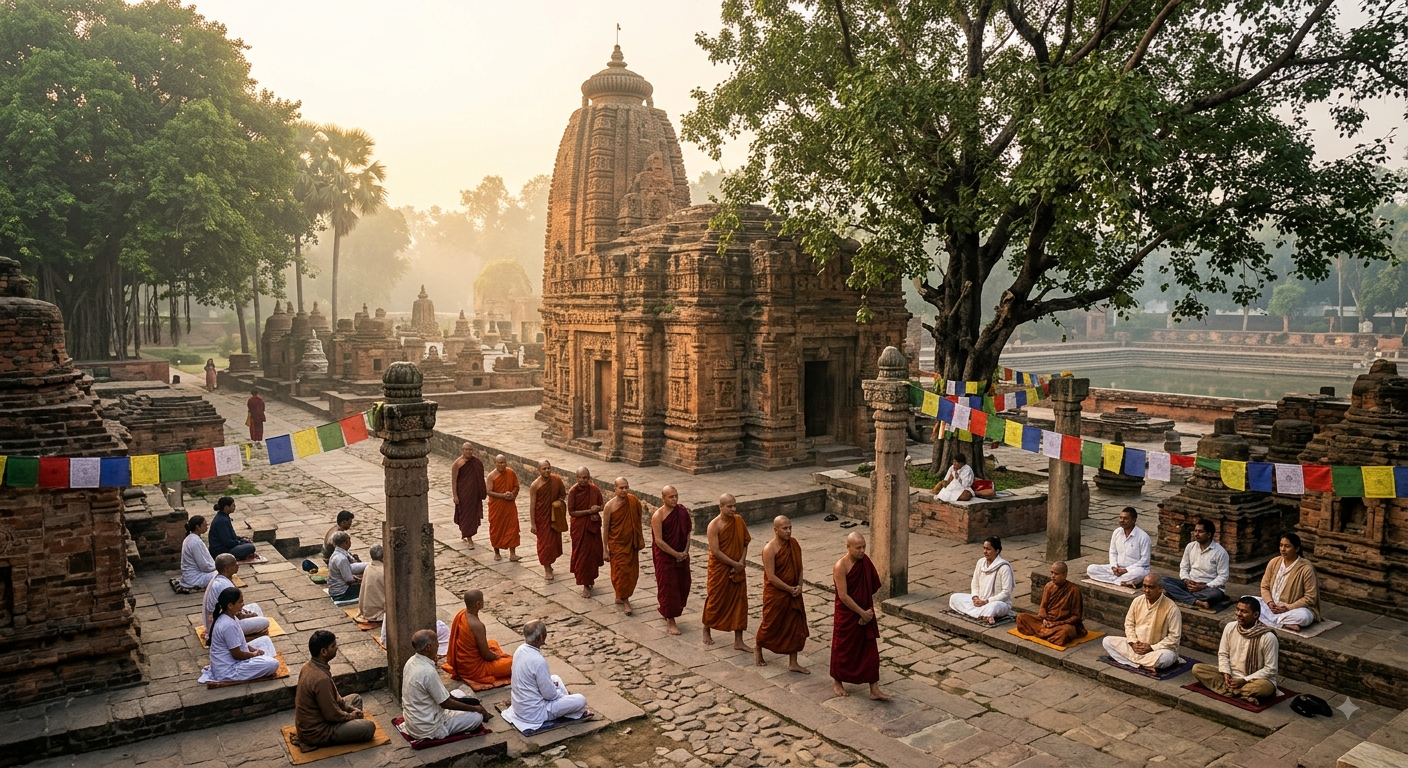
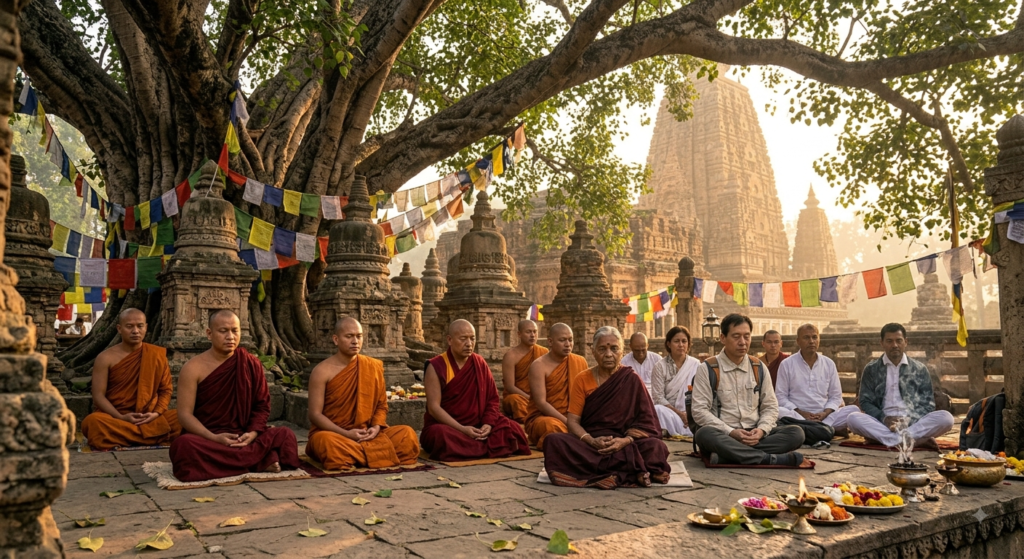
Monks quietly recite prayers. Pilgrims walk around the Bodhi Tree. Prayer flags move gently in the breeze. Meditation groups gather in shaded spaces. The soundscape changes from temple bells and chants to moments of almost complete silence.
For travelers, this creates an experience that goes beyond conventional sightseeing.
A journey to Bodh Gaya can become an opportunity to discover Buddhist philosophy, Indian history, sacred architecture, meditation, and the timeless human search for inner peace.
This complete Bodh Gaya Travel Guide takes you through the destination’s spiritual significance, Mahabodhi Temple, Bodhi Tree, Buddhist heritage, practical travel information, and experiences worth adding to your itinerary.
What Makes Bodh Gaya Spiritually Significant?
Bodh Gaya occupies a unique position in the history of Buddhism.
According to Buddhist tradition, Siddhartha Gautama spent years searching for an answer to the suffering experienced by human beings. After years of spiritual practice and meditation, he reached Bodh Gaya and eventually attained enlightenment while meditating beneath the Bodhi Tree.
That moment transformed Siddhartha into the Buddha, meaning “the Awakened One.”
The site therefore represents more than an important historical event. For Buddhists around the world, it represents the possibility of awakening, wisdom, compassion, and liberation.
UNESCO describes the Mahabodhi Temple Complex as having a direct association with the Buddha’s life and identifies it as the place connected with his attainment of supreme insight.
One of Buddhism’s Four Sacred Sites
Bodh Gaya is traditionally regarded as one of the four principal pilgrimage destinations connected with the life of Buddha.
The others are:
- Lumbini – associated with Buddha’s birth
- Sarnath – associated with his first sermon
- Kushinagar – associated with his passing into Parinirvana
Among these, Bodh Gaya holds a particularly profound place because it represents the moment of enlightenment.
For Buddhist pilgrims, visiting the Mahabodhi Temple is therefore not simply a sightseeing experience—it can be a deeply personal spiritual journey.
The Story of Buddha’s Enlightenment
The story begins with Siddhartha Gautama, a prince who left his privileged life after becoming deeply concerned about human suffering.
He searched for answers through teachers, meditation, and severe ascetic practices before eventually discovering a middle path between indulgence and extreme self-denial.
At Bodh Gaya, Siddhartha is traditionally believed to have seated himself beneath the Bodhi Tree and entered deep meditation.
After attaining enlightenment, he became the Buddha.
The significance of this event extended far beyond one individual.
The teachings that emerged from Buddha’s awakening eventually spread across Asia and influenced philosophy, art, architecture, meditation traditions, and spiritual practices across generations.
Today, people from countries including Sri Lanka, Thailand, Myanmar, Bhutan, Tibet, Japan, China, Vietnam, Nepal, and many others travel to Bodh Gaya to reconnect with this shared heritage.
Mahabodhi Temple – The Spiritual Heart of Bodh Gaya
The Mahabodhi Temple is the centerpiece of Bodh Gaya and the destination’s most important landmark.
Its towering brick architecture rises prominently above the surrounding complex, creating an unforgettable sight as visitors approach the sacred area.
The Bihar Tourism Department identifies the temple as a UNESCO World Heritage Site and describes it as the place associated with Buddha’s enlightenment beneath the Bodhi Tree.
A Monument of Extraordinary Historical Importance
The present Mahabodhi Temple dates primarily to the 5th–6th centuries CE, while the first temple at the location is associated with Emperor Ashoka in the 3rd century BCE.
The structure is particularly significant because it is among India’s earliest surviving Buddhist temples constructed substantially in brick.
UNESCO recognizes the temple’s architectural importance and its influence on the development of brick architecture over subsequent centuries.
The Main Shrine
Inside the temple is a revered image of the seated Buddha.
The Buddha is traditionally depicted touching the earth, symbolizing the moment of enlightenment and the calling of the earth to bear witness.
For pilgrims, standing inside the shrine can be an intensely moving experience.
The surrounding atmosphere is often filled with:
- Buddhist chants
- Meditation
- Prayer
- Offerings
- Quiet contemplation
The Bihar Tourism Department currently advises visitors to dress modestly, remove footwear before entering, maintain silence, and follow photography restrictions within the sacred complex.
The Sacred Bodhi Tree
Standing beside the Mahabodhi Temple is perhaps the most spiritually significant element of the entire complex—the Bodhi Tree.
Buddhist tradition identifies this location as the place beneath which Buddha attained enlightenment.
UNESCO describes the present tree as a believed direct descendant of the original Bodhi Tree associated with Buddha’s enlightenment.
A Place of Meditation
Visitors can often see pilgrims sitting quietly beneath the tree, meditating, reading scriptures, praying, or performing traditional devotional practices.
The experience is particularly powerful during quieter periods when the surrounding area becomes almost completely still.
You do not need to be Buddhist to appreciate the atmosphere.
For many travelers, simply sitting beneath the tree for a few minutes can become one of the most memorable moments of a visit to Bodh Gaya.
The Vajrasana – The Diamond Throne
Near the Bodhi Tree lies the Vajrasana, traditionally regarded as the “Diamond Throne” and the seat associated with Buddha’s enlightenment.
It is one of the most important objects within the Mahabodhi Temple complex.
The Vajrasana was preserved and associated with the site during the reign of Emperor Ashoka and remains an important focus for Buddhist pilgrims.
The Seven Sacred Places of Buddha’s First Weeks
One of the fascinating aspects of the Mahabodhi Temple Complex is that it preserves several locations traditionally associated with the seven weeks following Buddha’s enlightenment.
According to the traditional account, Buddha remained in the vicinity of the Bodhi Tree, spending each week in contemplation at different locations.
These include:
Week One
Bodhi Tree
The place associated with Buddha’s enlightenment.
Week Two
Animeshlochan Chaitya
Traditionally associated with Buddha gazing toward the Bodhi Tree.
Week Three
Ratnachakrama
The Jewel Walk, where Buddha is believed to have walked in meditation.
Week Four
Ratnaghar Chaitya
Another location associated with meditation following enlightenment.
Week Five
Ajapala Nigrodh Tree
Associated with Buddha’s contemplation and discussions with Brahmins.
Week Six
Muchalinda Lake
Traditionally associated with the story of the serpent king Muchalinda sheltering Buddha during a storm.
Week Seven
Rajayatana Tree
Another sacred location associated with Buddha’s post-enlightenment meditation.
UNESCO’s description of the Mahabodhi complex documents these locations and their traditional associations with the weeks immediately following enlightenment.
Bodh Gaya as a Global Buddhist Pilgrimage Centre
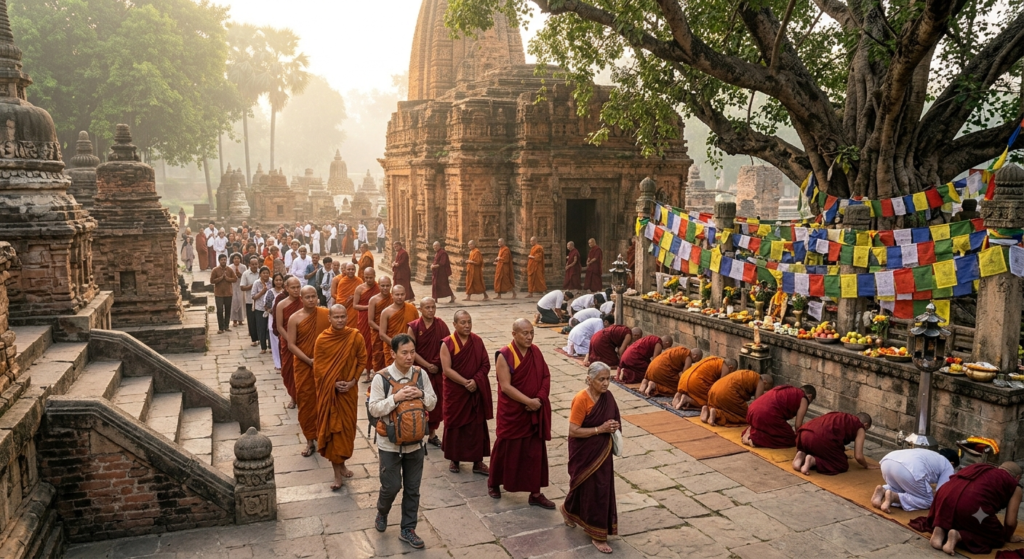
One of the most remarkable things about Bodh Gaya is its international character.
Walk through the streets surrounding the Mahabodhi Temple and you may encounter:
- Tibetan monks
- Thai pilgrims
- Japanese visitors
- Sri Lankan devotees
- Bhutanese monks
- Myanmar Buddhist groups
- Indian pilgrims
- International meditation practitioners
This diversity reflects the extraordinary geographical reach of Buddhism.
The destination therefore feels less like a conventional Indian pilgrimage town and more like a meeting point for Buddhist cultures from around the world.
Buddhist Monasteries from Around the World
Bodh Gaya is surrounded by monasteries and temples representing different Buddhist traditions.
Visitors can discover distinct architectural and spiritual influences from:
- Tibet
- Thailand
- Bhutan
- Japan
- Myanmar
- Sri Lanka
- Vietnam
The Tibetan Temple, for example, features Tibetan-style Buddhist architecture, prayer wheels, murals, Buddhist symbols, and a large Dharmachakra.
Exploring these monasteries gives travelers an opportunity to understand how Buddhism developed distinctive cultural expressions across Asia while maintaining shared philosophical foundations.
Why Bodh Gaya Belongs on Your Spiritual Travel List
Bodh Gaya offers something that few destinations can provide: the opportunity to stand in a place associated with an event that profoundly influenced the spiritual and intellectual history of humanity.
You can explore ancient architecture, observe living traditions, visit international monasteries, learn about Buddhist philosophy, or simply sit quietly beneath the Bodhi Tree.
And perhaps that is the greatest appeal of Bodh Gaya.
You don’t have to rush.
You don’t have to see everything.
Sometimes, the most meaningful experience is simply being present.
Top Spiritual Attractions in Bodh Gaya
Bodh Gaya’s spiritual significance extends beyond the Mahabodhi Temple.
The surrounding area is filled with monasteries, meditation centers, temples, sacred lakes, and historic sites that reveal different chapters of Buddhist history and the many cultural traditions that Buddhism has inspired across Asia.
If you have two or three days in Bodh Gaya, make time to explore these places rather than limiting your visit to the main temple complex.
Great Buddha Statue
One of the most recognizable landmarks in Bodh Gaya is the Great Buddha Statue.
The enormous seated Buddha rises above its landscaped surroundings and has become an important landmark for visitors and pilgrims.
The statue depicts Buddha in a meditative posture and creates a striking visual contrast with the surrounding greenery.
Why Visit?
The area around the statue is considerably more spacious than the main Mahabodhi Temple complex, making it suitable for:
- Quiet reflection
- Photography
- Meditation
- Understanding Buddhist iconography
- Appreciating large-scale Buddhist art
Visit during the early morning or late afternoon for softer light and a more peaceful atmosphere.
Tibetan Temple
The Tibetan Temple provides an opportunity to experience Tibetan Buddhist traditions within Bodh Gaya.
Its architecture, prayer wheels, murals, Buddhist imagery, and devotional atmosphere are noticeably different from some of the other monasteries around the town.
The temple is located close to the Mahabodhi Temple complex and can easily be incorporated into a walking itinerary. Bihar Tourism also identifies it as an important attraction for visitors exploring Bodh Gaya’s Buddhist heritage. (tourism.bihar.gov.in)
Prayer Wheels and Tibetan Buddhist Traditions
One of the most recognizable elements is the row of prayer wheels.
Visitors may observe devotees gently turning them while walking around the temple.
For travelers unfamiliar with Tibetan Buddhist practices, this provides a fascinating glimpse into the diversity of Buddhist devotional traditions.
Thai Monastery
The Thai Monastery is another important Buddhist landmark in Bodh Gaya.
Built in distinctive Thai architectural style, the monastery reflects Thailand’s deep connection with Bodh Gaya and the wider Buddhist pilgrimage tradition.
Its elegant rooflines, ornamental details, and peaceful surroundings make it particularly appealing to architecture enthusiasts and photographers.
The monastery is also a reminder that Bodh Gaya belongs to a much larger Asian Buddhist cultural network.
Royal Bhutan Monastery
The Royal Bhutan Monastery introduces visitors to Bhutanese Buddhist architecture and artistic traditions.
Its colorful details and intricate Buddhist artwork make it one of the most visually distinctive monasteries in Bodh Gaya.
Inside, visitors can appreciate traditional Buddhist imagery and craftsmanship associated with Bhutan.
For travelers interested in Himalayan culture, this is a worthwhile addition to a Bodh Gaya itinerary.
Japanese Temple and Indosan Nipponji Temple
Bodh Gaya’s international Buddhist character becomes particularly visible at its Japanese Buddhist temples.
The Indosan Nipponji Temple is known for its simple, peaceful architecture and Japanese Buddhist influence.
Compared with some of the more ornate temples in the area, its understated design encourages a quieter experience.
Spend a few minutes here without rushing.
The contrast between the different architectural traditions found around Bodh Gaya is one of the destination’s most interesting cultural experiences.
Muchalinda Lake
Located within the Mahabodhi Temple complex, Muchalinda Lake is associated with one of the best-known stories from Buddha’s life.
According to Buddhist tradition, Buddha meditated here during the sixth week after enlightenment.
A serpent king named Muchalinda is traditionally said to have protected Buddha from a storm by sheltering him beneath its hood.
A sculpture at the lake depicts this story.
The lake offers a quieter setting within the larger pilgrimage complex and is worth including in a slow exploration of Mahabodhi Temple.
Dungeshwari Cave Temples
For travelers interested in the life of Buddha before enlightenment, the Dungeshwari Cave Temples offer a fascinating extension to the Bodh Gaya journey.
The caves are traditionally associated with the period when Siddhartha Gautama practiced severe asceticism before discovering the Middle Way.
The journey to the caves also provides a different perspective on the landscape around Bodh Gaya.
Here, the experience is less about grand architecture and more about understanding the spiritual journey that preceded enlightenment.
Meditation and Spiritual Experiences in Bodh Gaya
You don’t have to be a practicing Buddhist to experience the contemplative atmosphere of Bodh Gaya.
The town provides numerous opportunities to slow down and reconnect with yourself.
Meditate Beneath the Bodhi Tree
Sitting quietly near the Bodhi Tree can be one of the most memorable experiences of the trip.
Rather than trying to photograph everything, consider setting aside some time simply to observe:
- The sound of chanting
- Pilgrims walking in prayer
- Monks reciting scriptures
- Temple bells
- Incense
- The movement of prayer flags
- The changing light around the temple
It is an experience that rewards stillness rather than speed.
Attend a Buddhist Prayer Session
Depending on the time of year and monastery schedule, visitors may encounter prayer sessions, chanting, meditation programs, and religious ceremonies.
Schedules can change, so check locally before planning your visit around a specific ceremony.
Always observe quietly and follow the instructions of temple or monastery staff.
Experience the Evening Atmosphere
Bodh Gaya takes on a particularly peaceful character around sunset.
As daylight fades, the illuminated Mahabodhi Temple and surrounding sacred spaces create an atmosphere that feels very different from the daytime crowds.
An evening walk around the temple complex can be an excellent way to end your day.
Best Time to Visit Bodh Gaya
The most comfortable period to visit Bodh Gaya is generally between October and March, when temperatures are more suitable for sightseeing and outdoor exploration.
October–November
Pleasant weather makes this a good period for:
- Temple visits
- Walking tours
- Photography
- Monastery exploration
December–February
These months bring cooler weather and are particularly popular with pilgrims and international visitors.
Mornings and evenings can be chilly, so carry warm layers.
March
Temperatures begin to rise, but early mornings can still be comfortable for sightseeing.
April–June
Summer can become extremely hot, making prolonged outdoor sightseeing uncomfortable.
If traveling during this period, plan temple visits during early morning or late afternoon.
July–September
The monsoon brings rainfall and higher humidity.
The landscape becomes greener, but rain can affect outdoor sightseeing and road travel.
How to Reach Bodh Gaya
Bodh Gaya is relatively accessible compared with many remote pilgrimage destinations.
By Air
The nearest airport is Gaya International Airport, located only a short distance from Bodh Gaya.
It is particularly convenient for international Buddhist pilgrims because the airport receives seasonal and international connectivity associated with pilgrimage traffic.
For travelers coming through larger Indian aviation hubs, Patna Airport is another option, followed by a road journey to Bodh Gaya.
By Train
The nearest major railway station is Gaya Junction.
Gaya has rail connections with several major Indian cities, making it one of the most convenient ways to reach the region.
From Gaya Junction, taxis, auto-rickshaws, and other local transport options can take travelers onward to Bodh Gaya.
By Road
Bodh Gaya is connected by road with:
- Gaya
- Patna
- Rajgir
- Nalanda
- Varanasi
Road travel is particularly useful if you’re combining Bodh Gaya with other destinations in Bihar’s Buddhist and heritage circuit.
Suggested 3-Day Bodh Gaya Itinerary
Day 1 – Mahabodhi Temple & Sacred Sites
Morning
- Arrive in Bodh Gaya
- Check into your accommodation
- Visit Mahabodhi Temple
Afternoon
Explore:
- Bodhi Tree
- Vajrasana
- Animeshlochan Chaitya
- Ratnachakrama
- Muchalinda Lake
Evening
- Return to the Mahabodhi Temple
- Observe evening prayers
- Spend quiet time around the sacred complex
Day 2 – Buddhist World Tour
Morning
Visit:
- Thai Monastery
- Royal Bhutan Monastery
- Tibetan Temple
Afternoon
Explore:
- Japanese Buddhist temples
- Great Buddha Statue
- Local Buddhist monasteries
Evening
Enjoy a peaceful walk through Bodh Gaya and explore local restaurants and shops.
Day 3 – Beyond Bodh Gaya
Morning
Visit the Dungeshwari Cave Temples.
Afternoon
Depending on your interests, consider a day trip toward:
- Gaya
- Rajgir
- Nalanda
Evening
Return to Bodh Gaya and prepare for departure.
Essential Travel Tips
A spiritual destination deserves a slightly different approach to travel planning.
1. Start Early
Visit the Mahabodhi Temple early in the morning when the atmosphere is generally quieter.
2. Dress Modestly
Wear comfortable clothing that covers shoulders and knees when visiting religious sites.
3. Carry Minimal Items
Security restrictions may apply at important religious sites. Carry only essential belongings.
4. Remove Footwear
Shoes must be removed before entering designated sacred areas.
5. Respect Photography Rules
Photography restrictions may apply in certain parts of the temple complex. Always follow current instructions.
6. Keep Your Voice Low
Remember that people around you may be meditating or praying.
7. Carry Water
Bodh Gaya can become warm during the daytime, particularly outside the winter season.
8. Carry Some Cash
Although digital payments are increasingly common, cash remains useful for small purchases, local transport, donations, and smaller establishments.
9. Allow Time for Stillness
Don’t fill every hour with sightseeing.
Leave time simply to sit, observe, meditate, or walk quietly.
Responsible Spiritual Tourism
Bodh Gaya is not simply a sightseeing destination. It is a living pilgrimage centre visited by Buddhists from across India and around the world.
Traveling responsibly here means understanding that the places you visit may hold profound religious significance for the people around you.
A respectful traveler observes, learns, and participates without treating sacred traditions merely as tourist attractions.
Respect Religious Practices
While visiting temples and monasteries:
- Maintain silence in meditation areas.
- Follow instructions from temple authorities.
- Avoid interrupting prayer sessions.
- Dress appropriately.
- Remove footwear where required.
- Never touch religious objects without permission.
- Avoid sitting on platforms or structures reserved for monks or pilgrims.
Small gestures of respect can make your experience more meaningful.
Support Local Communities
Your visit can contribute directly to the local economy.
Consider:
- Staying at locally operated hotels or guesthouses.
- Eating at local restaurants.
- Purchasing locally made handicrafts.
- Hiring local guides.
- Using local transportation.
- Supporting legitimate monastery or community initiatives.
Responsible spending helps ensure that tourism benefits the people who live in Bodh Gaya.
Temple and Monastery Etiquette
Bodh Gaya’s many temples and monasteries represent different Buddhist traditions, but respectful behavior is appreciated across them all.
Before Entering
- Dress modestly.
- Remove shoes when required.
- Switch your phone to silent.
- Follow security instructions.
- Carry only essential belongings.
Inside Sacred Areas
- Speak quietly.
- Avoid unnecessary conversations.
- Do not disturb people meditating.
- Follow designated walking routes.
- Do not touch statues or religious objects unless permitted.
During Prayer
If you encounter monks or devotees praying, simply observe from an appropriate distance.
You don’t need to participate in a religious practice to appreciate its significance.
Photography Guide
Bodh Gaya offers extraordinary opportunities for cultural, architectural, and documentary photography.
The challenge is capturing its atmosphere without disturbing the spiritual experience of others.
Best Photography Subjects
Consider photographing:
- Mahabodhi Temple
- Sacred Bodhi Tree
- Temple architecture
- Buddhist monks
- Prayer flags
- Prayer wheels
- Traditional offerings
- Monastery architecture
- Great Buddha Statue
- Muchalinda Lake
- Meditation scenes
- Evening illumination
Best Time for Photography
Sunrise
Early morning offers:
- Soft golden light
- Fewer visitors
- Atmospheric backgrounds
- Peaceful temple scenes
Late Afternoon
The warm light creates beautiful tones across the Mahabodhi Temple’s brick architecture.
Blue Hour
After sunset, the illuminated temple can provide dramatic architectural photographs.
Always follow current photography restrictions within sacred areas.
Photograph People Respectfully
Bodh Gaya provides countless opportunities for powerful human-interest photography.
However, monks, pilgrims, and local residents are not simply photographic subjects.
Ask before taking close-up portraits.
This is especially important when photographing:
- Elderly pilgrims
- Monks
- Children
- People during prayer
- Meditation sessions
- Religious ceremonies
A respectful request can turn a photograph into a meaningful human interaction.
What to Wear in Bodh Gaya
Bodh Gaya can be warm during much of the year, while winter mornings and evenings can be surprisingly cool.
For temple visits, choose modest, comfortable clothing.
Recommended Clothing
- Comfortable cotton trousers
- Loose-fitting shirts
- Long skirts or dresses
- Lightweight scarves
- Comfortable walking shoes
- Light jacket during winter
- Warm layer for December–January mornings
Avoid clothing that is excessively revealing when visiting religious sites.
Complete Bodh Gaya Packing Checklist
Clothing
✔ Comfortable walking clothes
✔ Modest temple-appropriate outfits
✔ Light scarf
✔ Comfortable shoes
✔ Sandals for easy removal at temples
✔ Light jacket
✔ Warm layer for winter
✔ Sunglasses
Spiritual & Travel Essentials
✔ Government-issued ID
✔ Hotel confirmation
✔ Small backpack
✔ Reusable water bottle
✔ Notebook or journal
✔ Personal medicines
✔ Basic first-aid kit
✔ Hand sanitizer
✔ Tissues/wet wipes
Photography Equipment
✔ Smartphone
✔ Camera
✔ Wide-angle lens
✔ Standard zoom lens
✔ Extra batteries
✔ Memory cards
✔ Power bank
✔ Lens cleaning cloth
Frequently Asked Questions About Bodh Gaya
What is Bodh Gaya famous for?
Bodh Gaya is famous as the place where Siddhartha Gautama attained enlightenment and became the Buddha, according to Buddhist tradition.
The Mahabodhi Temple Complex marks this sacred location.
Why is the Mahabodhi Temple important?
The Mahabodhi Temple is one of Buddhism’s most sacred pilgrimage sites and is directly associated with Buddha’s enlightenment.
The temple complex is recognized as a UNESCO World Heritage Site. (whc.unesco.org)
How many days are enough for Bodh Gaya?
Two to three days are generally sufficient for a first visit.
Three days allow enough time to explore the Mahabodhi Temple, monasteries, Great Buddha Statue, Dungeshwari Cave Temples, and other attractions without rushing.
What is the best time to visit Bodh Gaya?
The period from October to March is generally the most comfortable for sightseeing because temperatures are more pleasant than during the summer months.
Is Bodh Gaya suitable for non-Buddhist travelers?
Absolutely.
You do not have to be Buddhist to appreciate Bodh Gaya’s history, architecture, culture, meditation traditions, and spiritual atmosphere.
The destination can be particularly rewarding for travelers interested in history, philosophy, architecture, photography, and cultural heritage.
Can visitors meditate at the Bodhi Tree?
Visitors can generally spend time in the designated areas around the Bodhi Tree for prayer and meditation, subject to temple rules and crowd management.
Follow instructions from temple authorities and avoid disturbing other pilgrims.
Is photography allowed inside the Mahabodhi Temple?
Photography rules can vary by area and may change.
Visitors should always follow the current instructions displayed at the temple and given by authorities rather than assuming photography is permitted everywhere.
Is Bodh Gaya crowded?
Bodh Gaya can become particularly busy during important Buddhist observances and pilgrimage periods.
Early mornings are generally preferable for travelers seeking a quieter experience.
Can Bodh Gaya be combined with other destinations?
Yes.
Bodh Gaya can form part of a larger Buddhist and heritage circuit that includes destinations such as Rajgir, Nalanda, Sarnath, and other important Buddhist sites.
The Spiritual Experience of Bodh Gaya
The greatest attraction in Bodh Gaya cannot be photographed.
It is the feeling of being surrounded by people who have traveled thousands of kilometres for a moment of spiritual connection.
Sit beneath the Bodhi Tree and watch pilgrims walk slowly around the sacred area.
Listen to monks reciting prayers.
Observe people placing flowers and offerings.
Notice how visitors from different countries follow different traditions while gathering around the same sacred site.
This is what makes Bodh Gaya extraordinary.
It isn’t only about the historical Buddha.
It is about the continuing human search for wisdom, peace, compassion, and understanding.
A Slow Travel Approach to Bodh Gaya
Bodh Gaya rewards travelers who resist the urge to rush.
Instead of trying to visit every monastery in a single day, create space for reflection.
A meaningful day might look like:
Sunrise meditation → Mahabodhi Temple → Local breakfast → Monastery exploration → Quiet afternoon → Evening prayers
The destination becomes much more than a checklist of attractions when you allow yourself to experience it slowly.
Conclusion
Bodh Gaya Is More Than a Destination
There are places that tell us about history.
There are places that introduce us to new cultures.
And there are places that make us pause and think about our own journey.
Bodh Gaya does all three.
From the magnificent Mahabodhi Temple and sacred Bodhi Tree to the peaceful monasteries representing Buddhist traditions from across Asia, every corner of this ancient pilgrimage town carries a story.
But perhaps its greatest lesson is simplicity.
Siddhartha Gautama’s journey to enlightenment was not a journey of luxury or conquest. It was a search for understanding.
More than two thousand years later, people continue to arrive in Bodh Gaya carrying their own questions, hopes, prayers, and aspirations.
Some come as pilgrims.
Some come as travelers.
Some come searching for history.
Others simply come looking for a little peace.
Whatever brings you here, give yourself time to slow down.
Sit beneath the Bodhi Tree.
Walk quietly through the Mahabodhi Temple complex.
Listen to the chants.
Watch the pilgrims.
And allow Bodh Gaya to tell its story at its own pace.
That may be the most meaningful way to experience one of India’s most sacred spiritual destinations.
🌍 Explore More
“Travel doesn’t always take us somewhere new. Sometimes, it helps us see ourselves differently.”
🌍 Explore More: BlueJay Explorations
📖 Read more travel stories: TravelAnecdotes.com
📸 Follow the journey on Instagram
👍 Follow us on Facebook
🎥 Watch cinematic travel stories on YouTube